
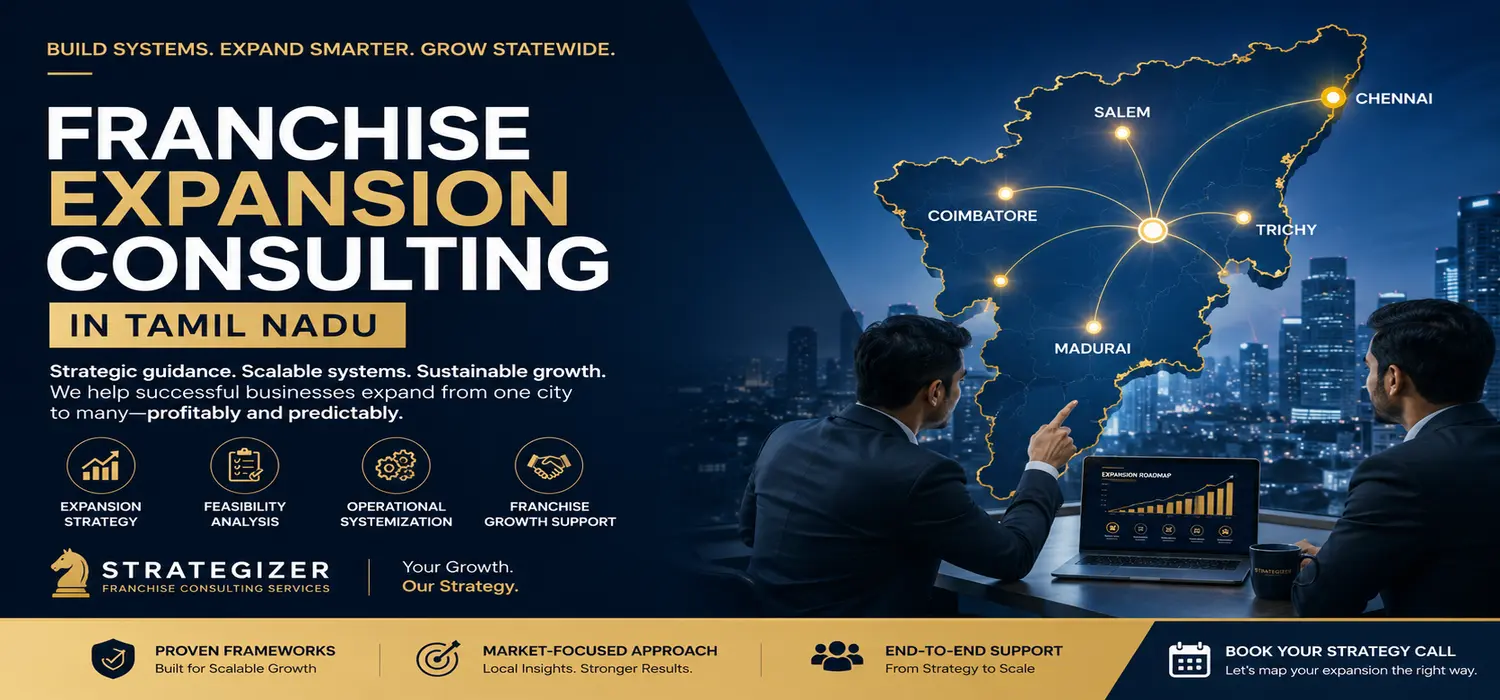
Table of Contents
ToggleFranchise Expansion Consulting in Tamil Nadu: What Growing Businesses Often Miss Before Scaling
A successful single-location business and a scalable franchise business are not automatically the same thing.
That distinction matters far more in today’s competitive expansion environment than many founders across TamilNadu initially expect. Businesses exploring franchise expansion consulting in Tamil Nadu often discover that growth challenges begin only after the second or third location starts operating independently.
A restaurant that performs exceptionally well in Chennai may struggle in Coimbatore because of supply chain inconsistency, staffing quality, rental economics, or customer preference differences. A salon brand that grows smoothly in Madurai may face operational breakdowns in Trichy because the founder built the business around personal supervision instead of repeatable systems.
This is where franchise expansion consulting in TamilNadu becomes less about “selling franchises” and more about building an expansion model that survives operational reality. Strong franchise expansion consulting in TamilNadu usually focuses on systemization, expansion sequencing, franchise readiness evaluation, and long-term operational consistency rather than aggressive outlet growth alone.
For many SMB owners, the biggest risk is not expansion failure. It is premature expansion.
The wrong franchise structure can dilute brand reputation, create legal disputes, damage unit economics, and overwhelm internal teams long before statewide growth happens. Businesses seeking franchise expansion consulting in Tamil Nadu are often trying to avoid exactly these problems while expanding into cities like Coimbatore, Salem, Trichy, or Madurai.
A good Franchise Consultant in Chennai helps identify whether the business is actually franchise-ready and if it is, how to scale without losing operational control.
Why Tamil Nadu Businesses Are Increasingly Exploring Franchise Expansion
Tamil Nadu has one of the strongest regional business ecosystems in South India for scalable consumer brands.
Several factors are driving this:
- Rapid Tier 2 and Tier 3 urban growth
- Strong regional food and retail loyalty
- Expanding middle-class spending
- High demand for trusted local brands
- Increasing commercial development outside Chennai
- Lower operating costs compared to metro-heavy expansion
Many SMBs exploring franchising also evaluate government-backed growth and MSME support frameworks during expansion planning. MSME Ministry offers business support initiatives relevant to scaling companies in India.
Businesses that once depended entirely on Chennai are now actively exploring cities like:
- Coimbatore
- Madurai
- Trichy
- Salem
- Tirunelveli
- Erode
- Vellore
- Hosur
This shift is especially visible in:
- Tiffin and biryani chains
- Tea and café concepts
- Beauty salons
- Preschool and coaching brands
- Fitness centers
- Retail lifestyle stores
- Quick-service restaurants
- Regional sweet brands
But expansion pressure creates a common mistake:
owners assume demand alone makes a business franchise-ready.
It does not.
A busy outlet is not enough. Sustainable franchising depends on system replication.
What Franchise Expansion Consulting Actually Involves
Many business owners misunderstand why businesses need franchise consulting and assume franchise consultants mainly prepare legal documents or help find franchise buyers.
In reality, comprehensive franchise consulting services typically cover operational architecture, financial modeling, market sequencing, and scalability planning.
A competent consulting process usually evaluates:
| Area | What Gets Assessed |
|---|---|
| Business Replicability | Can another operator realistically run this successfully? |
| Unit Economics | Will franchisees remain profitable after royalties and local costs? |
| SOP Readiness | Are systems documented clearly enough for scale? |
| Supply Chain Stability | Can product quality remain consistent across cities? |
| Brand Positioning | Does the business have regional expansion potential? |
| Founder Dependency | Does the business collapse without owner involvement? |
| Training Systems | Can staff and franchisees be onboarded efficiently? |
| Market Expansion Logic | Which cities should be prioritized first? |
| Legal Structure | Franchise agreements, IP protection, compliance |
| Operational Support | How ongoing franchise management will work |
Without these foundations, expansion becomes reactive instead of scalable.
The Biggest Expansion Problem in Tamil Nadu: Operational Consistency
This is especially true in food businesses.
Many restaurant owners underestimate how difficult standardization becomes outside their direct supervision.
A founder may personally monitor:
- spice balance
- kitchen hygiene
- vendor quality
- staff behavior
- customer escalation handling
But franchise systems cannot depend on founder presence.
A biryani chain expanding from Chennai to Salem and Madurai may suddenly encounter:
- inconsistent rice sourcing
- differing labor skill levels
- local vendor quality variation
- logistics delays
- uneven customer expectations
For food franchise brands, maintaining standardized compliance and food safety practices across locations becomes increasingly important as expansion scales through multiple cities. FSSAI provides regulatory guidance relevant to food business operators in India.
Consultants typically identify these risks early because operational inconsistency is one of the fastest ways to damage a growing regional brand.
The same issue appears in salons and educational businesses.
For salons:
- service quality variation
- staff retention instability
- uneven customer experience
For educational institutes:
- trainer quality inconsistency
- curriculum delivery variation
- branch-level management issues
Most expansion failures are operational failures disguised as growth problems.
Why Tier 2 and Tier 3 Expansion Requires Different Planning
Expansion inside Tamil Nadu is not operationally uniform.
Regional business infrastructure, industrial development patterns, and MSME growth initiatives across Tamil Nadu also influence franchise expansion potential in emerging cities. Tamil Nadu MSME Department provides state-level MSME ecosystem information relevant to expanding businesses.
A business model that works in Chennai may require adjustments in:
- pricing
- outlet size
- staffing structure
- inventory planning
- lease negotiation strategy
- local marketing
For example:
Chennai Expansion Logic
- Higher rentals
- Higher brand awareness value
- Premium positioning possible
- Greater competition density
Coimbatore or Trichy Expansion Logic
- Lower occupancy cost
- Strong local loyalty
- Different purchasing patterns
- Greater importance of community reputation
Some founders overbuild outlets because they copy Chennai formats into smaller cities.
Others underinvest in branding because they assume regional familiarity guarantees traction.
A strong franchise strategy consulting guide usually helps businesses align market selection, format strategy, operational complexity, investment expectations, and rollout sequencing.
- market selection
- format strategy
- operational complexity
- investment expectations
- rollout sequencing
That sequencing matters more than many realize.
Opening 10 poorly supported franchise units can permanently damage expansion momentum.
Opening 3 operationally stable units often creates stronger long-term scalability.
Franchise Readiness Is Usually Overestimated
This is one of the most common realities consultants encounter.
Founders often assume they are ready because:
- revenue is growing
- customers love the brand
- multiple investors are interested
- franchise inquiries are already coming in
But practical franchise readiness involves questions like:
Can another operator reproduce the same customer experience?
Are margins stable enough for both franchisor and franchisee?
Are procurement systems scalable?
Is staff training documented or informal?
Can quality audits be measured objectively?
Is there clear branch-level reporting?
Are vendor dependencies too centralized?
Is the business overly dependent on one key chef, manager, or founder?
A business can be commercially successful and still fail a proper franchise feasibility analysis for scalable expansion.
Businesses transitioning from founder-led operations into scalable systems often benefit from structured growth planning resources such as Startup India, especially during process formalization and expansion structuring stages.
That distinction saves companies from expensive expansion mistakes.
The Hidden Cost of Poor Franchise Structuring
Poor franchise systems often create long-term operational liabilities.
Common examples include:
- unrealistic royalty structures
- weak territory planning
- inadequate franchisee screening
- poor onboarding systems
- no operational audit framework
- vague support responsibilities
- unclear branding controls
The result is usually conflict.
Not immediately.
Usually after 12–18 months.
At that stage:
- franchisees complain about support
- unit profitability weakens
- operational quality declines
- brand consistency deteriorates
- expansion slows
Repairing broken franchise systems is usually harder than building properly from the beginning.
What Tamil Nadu Business Owners Should Prioritize Before Scaling
1. System Documentation
If knowledge exists only inside the founder’s head, scale becomes fragile.
Strong documentation includes:
- SOPs
- procurement workflows
- kitchen/service standards
- customer handling processes
- audit systems
- reporting structures
2. Unit-Level Financial Clarity
Many businesses track total business profitability but not branch-level profitability.
That becomes dangerous in franchising.
Each outlet must have:
- realistic setup costs
- operating margin visibility
- breakeven expectations
- labor ratio analysis
- inventory controls
3. Expansion Sequencing
Not every city should be opened simultaneously.
This is where a structured franchise planning process becomes critical for sustainable multi-city expansion.
A phased rollout generally creates:
- better operational learning
- fewer support failures
- stronger quality control
- improved franchisee onboarding
4. Franchisee Selection Discipline
A financially capable franchisee is not always a good operational partner.
Poor-fit franchisees often create:
- compliance issues
- brand inconsistency
- local reputation damage
- customer complaints
Strong screening matters.
5. Supply Chain Scalability
Many Tamil Nadu brands scale faster than their backend operations can support.
This becomes visible through:
- stock inconsistency
- taste variation
- vendor dependency issues
- logistics instability
Expansion speed should match operational maturity.
When Businesses Usually Need Franchise Expansion Consulting
Businesses often seek consulting support during one of these stages:
| Business Stage | Common Situation |
|---|---|
| Single Successful Outlet | Exploring whether franchising is viable |
| Multi-Branch Local Brand | Planning statewide expansion |
| Existing Franchise Brand | Facing operational inconsistency |
| Investor-Backed Expansion | Need structured growth planning |
| Plateaued Business Growth | Seeking asset-light scaling |
| Regional Brand Expansion | Moving outside home city |
The consulting requirement changes depending on maturity level.
A business starting franchising for the first time needs different support compared to a brand already managing multiple franchisees.
The Difference Between Franchise Sales and Franchise Development
This distinction is important.
Some firms focus mainly on selling franchise opportunities.
Others focus on building sustainable franchise systems.
Those are not the same service.
Selling franchises without operational readiness often creates future instability.
Sustainable franchise development usually includes:
- feasibility analysis
- franchise model design
- operational systems
- legal coordination
- expansion planning
- training frameworks
- franchise onboarding processes
- long-term scalability planning
Business owners should evaluate consultants based on operational depth, not just franchise sales promises.
Common Expansion Mistakes Tamil Nadu Brands Make
Expanding Too Fast
Growth outpaces support capability.
Copy-Pasting Chennai Models Everywhere
Different cities have different economics and customer behavior.
Underestimating Training Requirements
Operational quality weakens rapidly without structured training.
Choosing Franchisees Based Only on Capital
Operational discipline matters more long term.
Weak Backend Reporting
Without measurable reporting, scaling problems stay invisible too long.
No Territory Planning
Poor market overlap creates internal franchise conflict.
Overdependence on Founder Presence
The business becomes impossible to scale sustainably.
How Franchise Consultants Typically Support Multi-City Expansion
Understanding how consultants help scale brands becomes especially important once businesses move from single-city operations into regional expansion.
A practical consulting engagement may involve:
- business feasibility evaluation
- franchise strategy development
- operational documentation
- expansion roadmapping
- market prioritization
- franchise structure planning
- onboarding system creation
- training process design
- franchise marketing guidance
- franchisee qualification frameworks
In Tamil Nadu specifically, local market familiarity matters.
Regional operational realities differ significantly from national expansion assumptions often used in generic consulting models.
Understanding:
- regional customer behavior
- local lease dynamics
- staffing availability
- vendor ecosystems
- cultural buying patterns
can materially improve expansion planning quality.
Why Face-to-Face Consulting Still Matters for Regional Expansion
Many founders prefer local consulting support for practical reasons.
Expansion discussions often involve:
- financial sensitivity
- operational bottlenecks
- internal business weaknesses
- family business dynamics
- local vendor dependencies
- staffing concerns
These conversations are usually more productive in direct consultation environments rather than generic online advisory models.
For Tamil Nadu businesses, regional understanding often improves:
- expansion realism
- communication clarity
- execution alignment
- operational adaptation
Especially for traditional businesses transitioning into scalable franchise brands.
Choosing the Right Franchise Expansion Consultant
Business owners should evaluate consultants based on:
- operational understanding
- scalability planning capability
- regional market familiarity
- process clarity
- implementation practicality
- legal coordination ability
- long-term support structure
Be cautious of:
- unrealistic franchise sales projections
- “guaranteed expansion” claims
- expansion-first strategies without feasibility analysis
- vague consulting frameworks
- generic templated growth plans
A good consultant will often slow expansion initially to improve long-term scalability.
That is usually a positive sign.
Franchise Expansion Consulting in Tamil Nadu: Practical Next Steps
If your business is receiving franchise inquiries, expanding beyond Chennai, or considering structured statewide growth, the first step is not immediate franchise sales.
It is operational evaluation.
A structured feasibility and expansion assessment can help clarify:
- whether the business is franchise-ready
- what operational gaps exist
- which cities make sense first
- how much backend support is required
- what level of expansion is realistically manageable
For many growing SMB brands, sustainable expansion depends less on demand and more on operational repeatability.
That is the real foundation of scalable franchising.
Businesses exploring franchise expansion consulting in Tamil Nadu should focus on building systems capable of protecting quality, profitability, and brand consistency as growth accelerates.
FAQs About Franchise Expansion Consulting in Tamil Nadu
How do I know if my business is ready for franchising?
Which Tamil Nadu cities are best for franchise expansion after Chennai?
Can a small restaurant chain become a franchise brand?
What is the biggest risk in franchise expansion?
Conclusion
Franchise expansion is not simply a growth decision. It is a systems decision.
Tamil Nadu businesses expanding into multiple cities often discover that operational discipline matters more than market demand alone. Businesses that scale sustainably usually invest early in process clarity, financial structure, franchisee qualification, and backend operational control.
For founders working with experienced business expansion consultants in Chennai, statewide or national growth becomes significantly more manageable when operational systems are built before aggressive scaling begins.
The objective is not rapid outlet multiplication.
The objective is building a scalable business model that remains commercially stable as complexity increases.
Businesses working with Strategizer Franchise Consulting Services typically seek structured guidance around feasibility, operational readiness, expansion sequencing, and sustainable franchise development aligned with South Indian market realities.