
Table of Contents
ToggleBusiness Growth Strategy Through Franchising: A Practical Expansion Model for Companies That Want to Scale Faster Without Heavy Capital Risk
Most growing businesses eventually hit the same ceiling.
Demand exists. Brand awareness is improving. Customers are asking for additional locations or regional availability. Competitors are moving aggressively. But operationally, expansion starts becoming expensive, slow, and management-heavy.
Corporate-owned growth looks attractive on paper until the realities appear:
- rising lease costs
- staffing complexity
- regional management overhead
- delayed payback periods
- working capital pressure
- execution inconsistency across locations
This is where franchising becomes less of a “restaurant industry model” and more of a serious business growth strategy. Businesses evaluating scalable expansion models often first explore what franchise consultants actually do before deciding whether franchising is operationally viable for their business structure.
For broader industry context on how franchise systems operate globally, organizations like the International Franchise Association provide useful standards, operational resources, and franchise education materials.
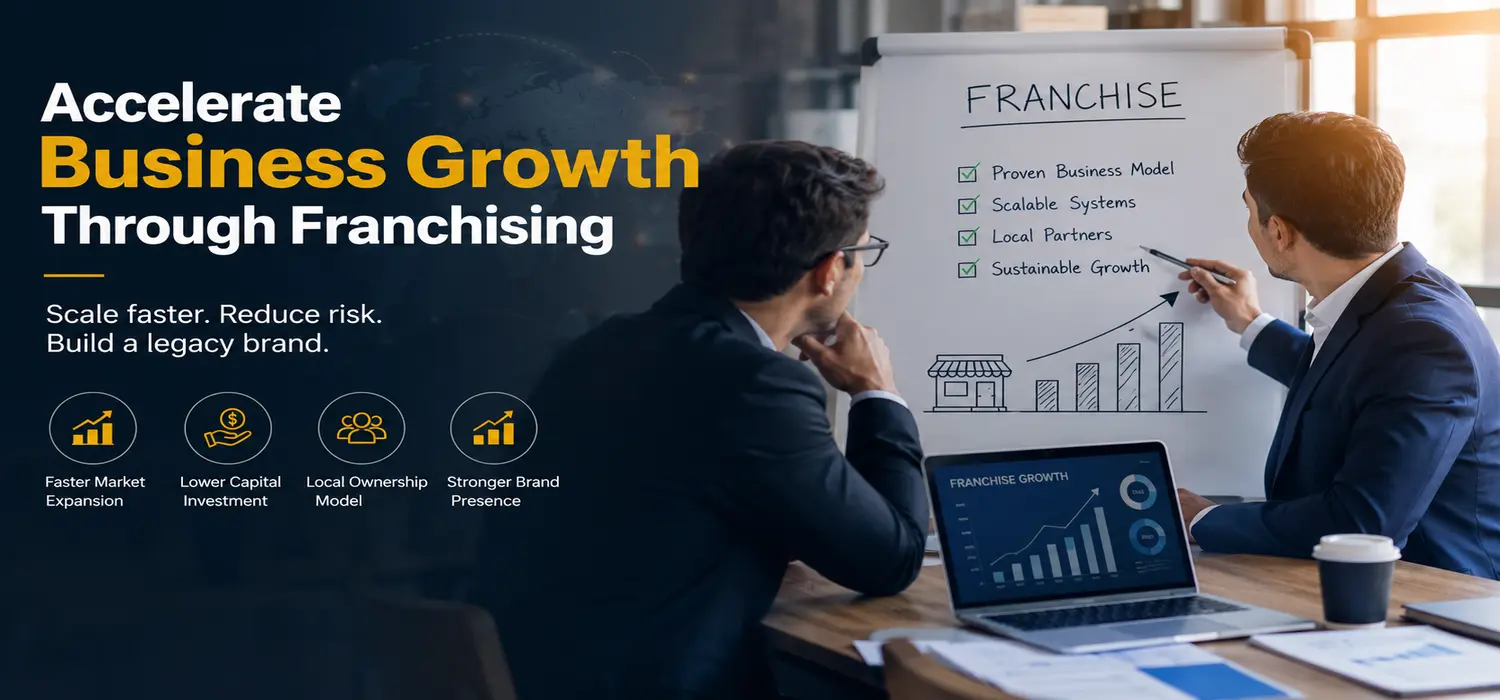
For many companies, franchising is not simply about opening more outlets. It is a capital-efficient market expansion framework that allows businesses to scale distribution, geographic presence, and market share without absorbing the full operational burden of each new unit.
That distinction matters.
A well-structured franchise system shifts expansion from:
- internally funded growth
to - partner-funded growth with centralized brand control.
But franchising is not automatically scalable. Poorly designed franchise systems often create operational chaos faster than they create revenue.
The businesses that scale successfully through franchising usually approach it strategically with strong operational systems, expansion sequencing, governance structures, unit economics, and franchisee support models already thought through before aggressive rollout begins.
This guide explains how business growth strategy through franchising actually works in practice, where it succeeds, where companies fail, and what leadership teams should evaluate before committing to franchise expansion.
Why Franchising Becomes Attractive During the Second Stage of Business Growth
Early-stage businesses typically focus on:
- product-market fit
- local profitability
- operational stability
- customer acquisition efficiency
But once a business proves repeatability in one or several locations, the strategic conversation changes.
Leadership teams begin asking:
- How quickly can we enter new markets?
- Can we scale without major debt?
- How do we expand before competitors dominate regional demand?
- Can the business operate without founder dependency?
- Is corporate-owned expansion becoming operationally inefficient?
At this stage, franchising becomes strategically relevant because it solves two growth constraints simultaneously:
- Capital limitation
- Management bandwidth limitation
Instead of internally funding every new location, the franchise model allows expansion capital to come from franchise partners.
Instead of directly managing hundreds of employees across regions, the business manages franchise operators who run local execution.
That fundamentally changes the economics of expansion.
At this stage, many leadership teams begin evaluating whether structured advisory support or franchise consulting services could reduce operational mistakes during expansion planning.
Franchising Is Not Just “Expansion” It Is Distribution Scaling
One of the biggest misconceptions around franchise development is that businesses think they are simply replicating branches.
They are not.
They are building a decentralized distribution system for their brand.
That changes how leadership must think about operations.
In a corporate-owned model:
- headquarters controls execution directly
In a franchise model:
- headquarters controls systems, standards, economics, brand governance, training, and performance frameworks
The role shifts from operator to system architect.
That transition is where many businesses struggle.
A company can be excellent at operating 5 locations and still fail at franchising because the business was never systemized deeply enough for third-party replication.
What Makes Franchising a Strong Business Growth Strategy
Faster Market Penetration
Corporate expansion often slows because each new location requires:
- internal capital
- centralized hiring
- management supervision
- operational setup
- regional oversight
Franchising distributes much of that burden.
A motivated franchisee brings:
- local capital
- local operational focus
- local market understanding
- owner-level accountability
This often accelerates regional penetration significantly faster than internally managed expansion.
Particularly in competitive industries, speed matters more than perfection.
Markets rarely stay open indefinitely.
Reduced Capital Pressure
For many SMBs and mid-market brands, expansion capital becomes the bottleneck long before demand disappears.
Opening multiple corporate locations simultaneously can strain:
- cash flow
- debt capacity
- investor expectations
- operational reserves
Franchising changes the financial structure of growth.
The franchisor invests primarily in:
- systems
- support infrastructure
- brand development
- training
- franchise recruitment
- operational governance
The franchisee typically funds:
- location setup
- staffing
- local operations
- lease obligations
- working capital
This lowers direct expansion risk considerably.
However, businesses often underestimate the investment required at the franchisor level. Franchise infrastructure still requires meaningful capital allocation.
Poor support systems create franchise failure quickly.
Many expansion-stage businesses compare franchise growth against traditional small business financing models and SBA-backed expansion frameworks discussed by the U.S. Small Business Administration
This is one reason why businesses increasingly explore why companies use franchise consulting during expansion before committing large capital toward corporate-owned scaling.
Scalability Without Extreme Corporate Headcount Growth
Corporate-owned expansion usually increases organizational complexity linearly.
More locations mean:
- more HR management
- more payroll administration
- more regional supervisors
- more operational firefighting
Franchising scales differently.
The organization shifts toward:
- field support
- compliance systems
- operational audits
- franchise success management
- centralized marketing systems
- training frameworks
This is operationally lighter than fully corporate scaling, though not necessarily simpler.
The complexity changes form.
Businesses That Usually Scale Well Through Franchising
Not every business should franchise.
The strongest franchise candidates usually share several characteristics:
| Strong Franchise Indicators | Why It Matters |
|---|---|
| Repeatable customer experience | Easier to standardize across operators |
| Strong unit economics | Franchisees need viable returns |
| Operational SOPs already exist | Reduces execution variability |
| Brand differentiation | Easier franchise recruitment |
| Multi-location operational proof | Demonstrates scalability |
| Moderate training complexity | Easier onboarding |
| Predictable demand patterns | Reduces franchise risk |
| Centralized supply chain capability | Maintains consistency |
Businesses commonly suited for franchise growth include:
- food service brands
- education and training centers
- fitness concepts
- salon and wellness chains
- retail formats
- home services
- healthcare support models
- specialty service businesses
- B2B operational services
The key factor is replicability.
If the business depends heavily on founder intuition, highly specialized talent, or inconsistent execution judgment, franchising becomes difficult.
Businesses researching industry-specific franchise benchmarks often use directories and market analysis resources from Entrepreneur Franchise Resources to evaluate competitive franchise categories and market maturity.
Where Franchise Expansion Commonly Fails
Most franchise failures do not happen because the market lacked demand.
They happen because the business expanded before operational maturity existed.
Weak Operational Documentation
Many companies assume:
“We know how to run the business.”
That is different from:
“Someone else can run the business consistently.”
Franchising requires:
- process documentation
- escalation systems
- operational workflows
- compliance frameworks
- quality control standards
- measurable KPIs
Without operational clarity, franchise inconsistency appears rapidly.
Many of these risks are usually identified during a proper franchise feasibility analysis before franchise rollout begins.
Recruiting Franchisees Too Aggressively
Fast franchise sales can look impressive early.
But poor franchisee selection creates long-term damage:
- operational inconsistency
- customer dissatisfaction
- legal disputes
- brand dilution
- territory conflict
- support overload
Strong franchise systems prioritize operator quality over short-term expansion velocity.
Not every investor becomes a good franchise operator.
Underestimating Franchise Support Requirements
A common misconception:
“Franchisees run the business themselves.”
In reality, under-supported franchisees usually struggle.
Franchisors still need:
- onboarding systems
- launch support
- operational audits
- field assistance
- training updates
- marketing systems
- technology infrastructure
- reporting systems
As networks grow, support complexity increases substantially.
Expanding Geography Too Early
Regional clustering matters more than many founders realize.
Scattered expansion creates:
- support inefficiency
- inconsistent regional marketing
- supply chain problems
- travel overhead
- weak territory economics
Well-run franchise systems often expand concentrically:
- Dominant core market
- Adjacent regional clusters
- State-level density
- Multi-state expansion
Density usually beats random geographic spread.
The Operational Transition Most Founders Underestimate
Franchise expansion changes leadership responsibilities dramatically.
Founders often believe they are scaling operations.
Actually, they are scaling systems, governance, and organizational clarity.
The business gradually becomes:
- less founder-operated
- more process-dependent
- more metrics-driven
- more compliance-oriented
This transition creates friction internally.
Common leadership challenges include:
- delegating operational authority
- standardizing decision-making
- enforcing brand consistency
- building franchise accountability systems
- separating corporate and franchise economics
- managing franchisee expectations
Many businesses are emotionally ready for franchising before they are structurally ready.
This transition phase often becomes easier when businesses follow a structured franchise planning process instead of approaching expansion reactively.
| Factor | Corporate-Owned Growth | Franchise Growth |
|---|---|---|
| Capital Requirement | High | Lower Direct Capital Exposure |
| Operational Control | Maximum | Shared Operational Control |
| Expansion Speed | Slower | Faster Potential Scaling |
| Profit Retention | Higher Per Unit | Lower Per Unit but Scalable |
| Organizational Complexity | Heavy Internal Staffing | Franchise Support Complexity |
| Risk Exposure | Centralized | Distributed |
| Geographic Expansion | Resource Intensive | Easier Regional Scaling |
| Brand Consistency | Easier to Enforce | Requires Systems Discipline |
Neither model is universally better.
Some businesses succeed with hybrid structures:
- flagship corporate locations
- regional franchise expansion
- strategic company-owned training units
Hybrid expansion often creates better operational balance.
Franchising Works Best When Systems Are Already Stable
One overlooked reality:
Franchising amplifies operational quality both good and bad.
If customer experience is inconsistent before franchising, scaling usually magnifies those inconsistencies.
Before franchise rollout, businesses should evaluate:
- SOP maturity
- technology systems
- CRM workflows
- training documentation
- reporting structures
- financial controls
- vendor systems
- customer experience consistency
Franchise development should typically happen after operational stabilization, not before it.
The Economics Behind Sustainable Franchise Expansion
Sophisticated founders increasingly evaluate franchise growth through system economics rather than unit count.
Important metrics include:
- average unit profitability
- franchisee payback period
- support cost per franchisee
- royalty sustainability
- territory viability
- franchisee retention
- network-wide operating consistency
A network with fewer healthy franchisees is usually stronger than a rapidly expanding network with weak unit economics.
Short-term franchise sales growth can hide long-term structural problems.
Technology Is Now Central to Franchise Scalability
Modern franchise systems increasingly depend on centralized technology infrastructure.
Without operational visibility, scaling becomes difficult.
Critical systems often include:
- POS integrations
- franchise reporting dashboards
- CRM systems
- marketing automation
- LMS training systems
- compliance tracking
- inventory visibility
- support ticket systems
Technology reduces operational fragmentation across locations.
It also improves franchise accountability.
Many older franchise systems struggle because operational data remains disconnected across franchise networks.
As franchise systems become larger, businesses often require broader franchise strategy consulting frameworks to maintain operational consistency across multiple regions.
Why Strategic Franchise Consulting Matters
Businesses often attempt franchise expansion internally first.
The problem is that franchise development is multidisciplinary.
It touches:
- operations
- legal structuring
- territory planning
- unit economics
- recruitment systems
- support architecture
- expansion sequencing
- branding
- franchise sales processes
This is why many growing companies work with specialized franchise advisors or expansion consultants.
A strong franchise consulting process usually helps businesses:
- determine franchise readiness
- identify operational gaps
- structure scalable systems
- define franchise economics
- build training frameworks
- create expansion roadmaps
- reduce avoidable scaling mistakes
Businesses researching how advisors support large-scale expansion can also explore how consultants help scale brands for deeper operational insight into franchise-led growth systems.
For businesses exploring scalable expansion models, structured guidance around franchise readiness, operational systems, territory planning, and expansion sequencing becomes critical before aggressive rollout begins. Firms such as strategizer franchise consulting services often help businesses evaluate whether franchising is operationally viable before large-scale investment decisions are made.
related resources like:
- “What Does a Franchise Consultant Do”
- “Franchise Feasibility Analysis”
- “Franchise Planning Process”
- “Franchise Strategy Consulting Guide”
- “How Consultants Help Scale Brands”
can provide deeper operational clarity around the franchise development lifecycle.
Businesses evaluating regional rollout opportunities may also benefit from localized expansion guidance through resources such as:
- “Franchise Expansion Consulting in Tamil Nadu”
- “Business Expansion Consultants in Chennai”
- “Franchise Consulting Services Explained”
These supporting topics help create a clearer decision framework before capital is committed to expansion.
When Franchising May Not Be the Right Strategy
Franchising is powerful, but not universally appropriate.
It may not fit businesses that:
- rely heavily on specialized founder expertise
- lack operational consistency
- require highly technical labor
- have weak unit economics
- operate in low-margin categories
- depend on hyper-local customization
- cannot standardize customer delivery
In some cases:
- licensing
- joint ventures
- regional partnerships
- corporate-owned growth
- distributor expansion
may create better long-term outcomes.
The right model depends on operational realities, not trend appeal.
Building a Realistic Franchise Expansion Roadmap
Businesses considering franchise expansion should typically evaluate five stages:
1. Operational Stability
Can the business operate consistently without founder dependency?
2. Replication Readiness
Can a third-party operator realistically reproduce outcomes?
3. Financial Viability
Do unit economics support both franchisee profitability and franchisor sustainability?
4. Support Infrastructure
Can the business support franchisees at scale?
5. Expansion Sequencing
Is there a realistic market rollout strategy?
Skipping these stages usually creates scaling instability later.
Businesses preparing for regional growth often seek specialized franchise expansion consulting in Tamil Nadu to better understand territory sequencing, regional demand concentration, and support infrastructure planning.
Franchising Is Ultimately a Systems Business
The most successful franchise brands are rarely the most charismatic.
They are usually the most operationally disciplined.
Strong franchise systems consistently prioritize:
- repeatability
- accountability
- support quality
- operational clarity
- franchisee economics
- long-term brand consistency
That is what creates durable network growth.
Not hype. Not aggressive franchise sales. Not rapid unit announcements.
The businesses that scale sustainably through franchising tend to think like infrastructure builders, not just marketers.
FAQs About Business Growth Strategy Through Franchising
How does franchising help businesses grow faster?
What types of businesses scale best through franchising?
What is the biggest risk in franchise expansion?
Is franchising cheaper than corporate-owned expansion?
Conclusion
Business growth strategy through franchising is not simply a faster way to open locations.
It is a different operating model entirely.
When structured correctly, franchising allows businesses to:
- scale market presence faster
- reduce direct capital burden
- expand through partner operators
- accelerate regional penetration
- build long-term distribution networks
But franchising also increases the importance of operational clarity.
Weak systems become visible quickly at scale.
The businesses that succeed are usually the ones that:
- standardize early
- expand strategically
- support franchisees consistently
- prioritize sustainable economics over rapid franchise sales
For leadership teams evaluating expansion options, the real question is not:
“Can we franchise?”
It is:
“Can our business be replicated consistently, profitably, and sustainably by independent operators at scale?”
That distinction determines whether franchising becomes a growth accelerator or an operational liability.
For companies actively evaluating scalable franchise expansion models, working with experienced franchise consultants in Chennai can help clarify operational readiness, growth sequencing, and franchise system viability before large-scale rollout begins.
For companies exploring structured expansion pathways, working with experienced partners such as strategizer franchise consulting services can help clarify franchise readiness, operational scalability, and long-term expansion sequencing before large-scale rollout decisions are made.