
Table of Contents
ToggleFranchise Strategy Consulting Guide: What Actually Helps Businesses Scale Through Franchising
Franchising looks deceptively simple from the outside.
A business develops a successful model, creates franchise packages, signs franchisees, and expands into new markets. That is the public-facing version.
Operationally, it is far more complex.
Many growing brands assume franchise expansion is primarily a sales exercise recruit franchisees, collect fees, and grow locations. In reality, sustainable franchise growth depends on whether the business can repeatedly transfer operational clarity, financial predictability, and brand consistency across different operators, cities, and market conditions.
That is where Franchise Consultants in Chennai become valuable.
Not because consultants “make a business a franchise,” but because expansion introduces structural problems most founder-led businesses were never originally designed to handle.
This guide explains what franchise strategy consulting actually involves, when businesses typically need it, where expansion plans usually fail, and how founders can evaluate whether franchising is commercially realistic before investing heavily into development.
Businesses exploring the franchise business model often underestimate the operational systems required for sustainable expansion.
What Is Franchise Strategy Consulting?
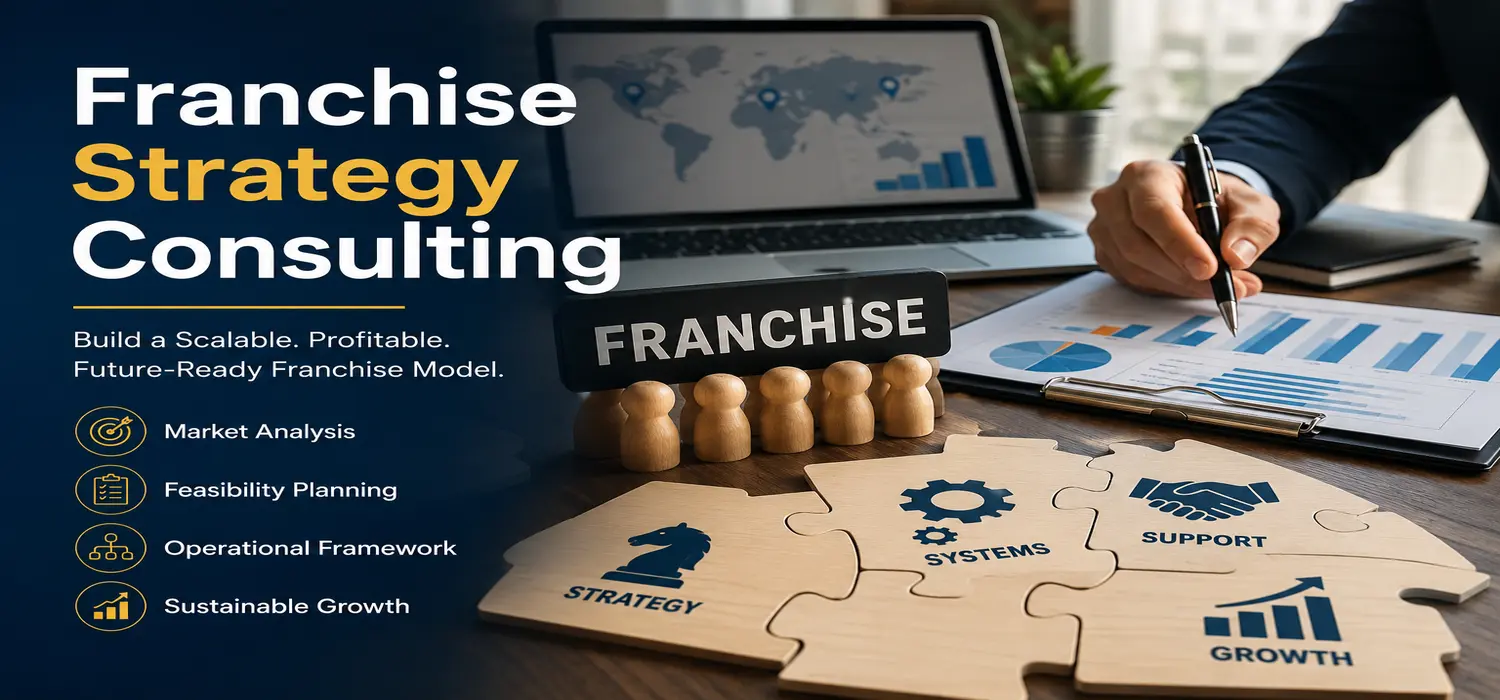
Business Strategy franchise strategy consulting is the process of helping businesses design, evaluate, structure, and scale a franchise expansion model in a commercially sustainable way.
It combines elements of:
- operational system design
- growth planning
- franchise development
- financial modeling
- market expansion strategy
- process standardization
- franchisee onboarding systems
- territory planning
- scalability assessment
Businesses usually explore this process while understanding What Does a Franchise Consultant Do before planning expansion.
A good franchise consultant is not just helping a company “sell franchises.”
They are helping answer harder questions:
- Can this business operate consistently without founder dependency?
- Is the unit economics stable enough for franchisees?
- Which parts of the business are scalable and which are fragile?
- What operational systems are missing?
- How much support overhead will expansion create?
- Is the business ready for multi-location management?
- Can the brand survive inconsistent operators?
Those questions matter more than logo design, franchise brochures, or recruitment campaigns.
Why Businesses Seek Franchise Strategy Consulting
Most founders approach franchise consulting during one of four situations.
This is also why many growing brands research Why Businesses Need Franchise Consulting before scaling operations.
1. Growth Has Started Outpacing Operational Clarity
The original outlet works well because the founder is heavily involved.
But replication becomes difficult because:
- decisions live inside people instead of systems
- training is informal
- vendor relationships are centralized
- customer experience depends on specific staff members
- reporting is inconsistent
Expansion exposes operational gaps very quickly.
A consultant helps identify whether the business is truly transferable or still personality-driven.
2. The Brand Wants Faster Geographic Expansion
Many SMB owners reach a point where company-owned expansion becomes capital intensive.
Opening branches directly requires:
- higher staffing overhead
- local supervision
- working capital
- inventory investment
- centralized operational management
Franchising shifts some expansion risk toward franchisees, but it also increases system-management complexity.
That tradeoff is often underestimated.
3. Existing Franchise Operations Are Becoming Difficult to Control
Some brands already have franchisees but experience:
- inconsistent customer experience
- weak compliance
- pricing conflicts
- training breakdowns
- territory disputes
- poor reporting visibility
- franchisee churn
In these situations, franchise strategy consulting becomes less about expansion and more about stabilization.
Growth without operational governance usually compounds problems.
4. Investors or Expansion Partners Need Structured Scalability
A business may attract investor interest but lack:
- documented systems
- scalable operating procedures
- expansion roadmaps
- franchise profitability models
- support frameworks
Consultants often help organize the business into something operationally expandable rather than founder-dependent.
Franchise Expansion Fails More Often from Operations Than Sales
One of the biggest misconceptions in the franchising industry is that franchise growth is primarily a lead-generation problem.
It usually is not.
Many franchise systems struggle because:
- franchisees are onboarded too quickly
- support capacity is insufficient
- unit economics are unrealistic
- operations were never standardized
- territory planning is weak
- training systems are incomplete
- reporting infrastructure is immature
A business can recruit franchisees faster than it can support them.
That creates short-term revenue and long-term instability.
Strong franchise strategy consulting focuses heavily on operational readiness before aggressive expansion begins.
What Franchise Strategy Consultants Actually Work On
The scope varies depending on business maturity, but most consulting engagements involve several core areas.
Franchise Feasibility Analysis
Before expansion, the consultant evaluates whether the business model is realistically franchiseable.
This usually includes:
- profit margin analysis
- operational repeatability
- staffing dependency evaluation
- market scalability
- pricing consistency
- local adaptability
- competitive positioning
- supply chain stability
A business can be profitable and still be difficult to franchise.
For example:
- highly chef-dependent restaurants
- businesses requiring specialist labor
- founder-led service companies
- operations with inconsistent delivery processes
Franchise feasibility is about replicability, not just profitability.
A structured Franchise Feasibility Analysis helps businesses identify scalability risks before expansion begins.
The International Franchise Association also emphasizes operational consistency and support systems as core franchise scalability factors.
This naturally connects with broader cluster topics like:
- “Franchise Feasibility Analysis”
- “Why Businesses Need Franchise Consulting”
- “Business Growth Strategy Through Franchising”
Franchise Operating Model Development
Once feasibility is established, the business needs operational structure.
This includes:
- SOP development
- onboarding frameworks
- support systems
- escalation processes
- reporting structures
- quality control standards
- operational workflows
This stage is often underestimated because founders already “know how the business works.”
Most businesses only understand the operational depth involved after reviewing detailed Franchise Consulting Services Explained frameworks.
But undocumented operational knowledge does not scale well.
Franchisees require systems that are:
- teachable
- measurable
- repeatable
- auditable
Not just founder intuition.
Territory & Expansion Planning
Poor territory planning creates long-term conflict.
Consultants typically help define:
- expansion sequencing
- regional rollout priorities
- market saturation limits
- territory protections
- demographic alignment
- logistics feasibility
Many brands expand reactively instead of strategically.
For example:
- signing franchisees in isolated markets
- expanding into cities without support infrastructure
- overcommitting to regions without demand validation
A franchise network grows more efficiently when expansion follows operational support capability.
This becomes especially important during structured Franchise Planning Process execution across multiple markets.
Not just franchise sales momentum.
Franchisee Recruitment Strategy
Recruitment quality matters more than recruitment speed.
One strong franchisee can stabilize regional growth.
One weak franchisee can create years of operational damage.
Consultants often help businesses refine:
- franchise qualification criteria
- discovery processes
- financial screening
- onboarding expectations
- operational suitability checks
The wrong franchisees are expensive.
Not immediately.
Operationally.
Financial Structuring & Commercial Viability
This area becomes especially important for SMB founders.
Many businesses create franchise pricing models without understanding:
- franchisee ROI timelines
- local operating costs
- support overhead
- regional pricing sensitivity
- royalty sustainability
- training costs
- marketing fund realities
Aggressive franchise fee structures may improve short-term revenue while damaging franchisee profitability.
That tension is common in immature franchise systems.
Good consulting introduces commercial realism into expansion planning.
This becomes especially important during small business growth planning where expansion costs, staffing overhead, and operational support structures directly affect long-term sustainability.
Technology & Reporting Infrastructure
As franchise networks grow, visibility becomes critical.
Consultants may recommend:
- POS integrations
- reporting dashboards
- centralized CRM systems
- audit systems
- franchise communication platforms
- operational tracking tools
Without standardized reporting:
- performance issues surface late
- franchise support becomes reactive
- compliance deteriorates
- benchmarking becomes difficult
Operational visibility becomes increasingly important after the first few franchise locations.
Strong multi-location operations management frameworks help franchise brands maintain consistency across geographically distributed outlets.
Common Mistakes Businesses Make Before Franchising
Expanding Before Systems Are Stable
Some founders try franchising because:
- demand is increasing
- competitors are scaling
- expansion sounds attractive
But operational inconsistency becomes magnified across locations.
If one outlet struggles with:
- staffing turnover
- inconsistent quality
- weak reporting
- training dependency
those problems usually multiply during franchising.
Treating Franchising Like Passive Income
Franchise businesses still require:
- operational oversight
- compliance management
- franchisee support
- training updates
- conflict resolution
- performance monitoring
Franchising is scalable.
It is not maintenance-free.
Many founders underestimate how consultants help operationally stabilize growth during How Consultants Help Scale Brands initiatives.
Overestimating Franchisee Capability
Many founders assume franchisees will “figure things out.”
Strong operators might.
Average operators usually need:
- structured onboarding
- standardized systems
- clear escalation pathways
- ongoing operational support
The franchise model must support normal operators, not exceptional ones.
Underestimating Support Costs
Expansion creates recurring overhead:
- training teams
- field support
- operations managers
- marketing coordination
- audit systems
- technology management
Some businesses sell franchises profitably but fail operationally because support infrastructure was never budgeted properly.
How SMB Owners Should Evaluate Franchise Readiness
Before investing heavily into franchise development, founders should assess several realities honestly.
| Area | Key Question |
|---|---|
| Operations | Can the business run consistently without founder dependency? |
| Financials | Are unit economics strong enough for franchisees to profit? |
| Training | Can new operators realistically learn the system? |
| Scalability | Will support systems survive multi-location expansion? |
| Brand Consistency | Can quality remain stable across different operators? |
| Leadership | Is management prepared for network oversight instead of direct control? |
This stage is where many businesses benefit from structured franchise planning rather than rushing into documentation and franchise sales.
Franchise Strategy Consulting Is Different From Franchise Sales
This distinction matters.
Some providers focus mainly on:
- lead generation
- franchise marketing
- franchise sales campaigns
Those services may help recruit franchisees.
But strategy consulting focuses earlier in the process:
- whether the model is scalable
- what operational systems are missing
- what support capacity is required
- how expansion should be sequenced
- where operational risks exist
Without strategy, franchise sales can accelerate structural problems.
How Franchise Consulting Changes as Businesses Scale
The needs of a 2-location business differ significantly from a 50-location network.
Early Stage Franchise Brands
Usually focus on:
- feasibility
- documentation
- franchise structure
- onboarding systems
- pilot testing
Growth-Stage Franchise Systems
Typically focus on:
- regional scaling
- support infrastructure
- reporting systems
- compliance management
- franchisee performance optimization
Mature Franchise Networks
Often focus on:
- operational standardization
- network profitability
- territory restructuring
- leadership systems
- multi-brand expansion strategy
Franchise consulting evolves with organizational complexity.
Regional Expansion Adds Additional Complexity
For businesses expanding across regions like Tamil Nadu or cities such as Chennai, local operational realities matter more than many founders expect.
Regional differences can affect:
- staffing availability
- rental economics
- customer behavior
- pricing sensitivity
- vendor consistency
- training requirements
- regulatory processes
Expansion strategies that work in one city may not transfer cleanly into another market.
A well-planned market expansion strategy usually considers regional staffing realities, customer behavior differences, and operational support capacity before scaling aggressively.
This is why “Franchise Expansion Consulting in Tamil Nadu” or “Business Expansion Consultants in Chennai” often require region-specific operational planning instead of generic national growth models.
When Businesses Should Delay Franchising
Not every business should franchise immediately.
In some situations, delaying expansion is the smarter decision.
Examples include:
- unstable unit economics
- high founder dependency
- inconsistent customer experience
- unresolved staffing problems
- unclear positioning
- weak financial controls
- poor operational documentation
Franchise expansion amplifies existing systems.
It rarely fixes broken ones.
What Founders Should Expect From a Franchise Strategy Consultant
A competent consultant should improve clarity, not create confusion.
They should help founders:
- identify operational gaps
- evaluate scalability realistically
- prioritize expansion sequencing
- avoid premature growth
- structure support systems
- improve replicability
- build commercially sustainable frameworks
The goal is not to make franchising look exciting.
The goal is to make expansion workable.
That distinction matters.
How Strategizer Franchise Consulting Services Approaches Franchise Planning
Strategizer Franchise Consulting Services focuses on practical franchise growth planning rather than surface-level expansion packaging.
For SMB owners and founders, that often means:
- evaluating operational readiness before aggressive expansion
- identifying scalability bottlenecks early
- structuring sustainable franchise systems
- improving process standardization
- planning region-aware expansion strategies
- balancing growth ambition with operational capacity
For many businesses, the challenge is not whether franchising is possible.
It is whether the business can scale without operational instability damaging the brand long term.
Frequently Asked Questions
What does franchise strategy consulting include? +
How do consultants determine whether a business is franchise-ready? +
Is franchise consulting only useful for large brands? +
What is the difference between franchise consulting and franchise sales? +
Conclusion
Franchise expansion is often discussed as a growth shortcut.
Operationally, it is usually a systems challenge.
Many businesses eventually use franchising as part of a broader Business Growth Strategy Through Franchising approach rather than just rapid outlet expansion.
Businesses that scale successfully through franchising tend to share several characteristics:
- repeatable operations
- realistic financial structures
- strong training systems
- measured expansion pacing
- operational visibility
- disciplined franchisee selection
Franchise strategy consulting helps businesses identify whether those foundations actually exist before expansion complexity increases.
For founders, the most important question is not “Can we franchise?”
It is:
“Can this business scale consistently across different operators, markets, and growth stages without operational instability undermining the brand?”
That question deserves careful planning before rapid expansion begins.