
Table of Contents
ToggleFranchise Planning Process: How to Prepare Your Business for Scalable Franchise Expansion
Many businesses reach a frustrating point in growth.
The first outlet works. Customers love the product. Revenue is stable. Operations feel manageable. Word-of-mouth spreads naturally. At that stage, founders often assume franchising is the obvious next move.
Then reality appears.
Legal documentation becomes complicated. Unit economics start behaving differently across locations. Staff quality varies. Vendor consistency breaks. Training becomes difficult to standardize. Founder involvement quietly turns into a bottleneck.
This is where the franchise planning process becomes critical.
A well-structured franchise expansion plan is not simply about “selling franchises.” It is about determining whether the business can replicate operationally, financially, and culturally without collapsing under scale pressure.
Businesses exploring franchise expansion often review operational and compliance frameworks published by the International Franchise Association (IFA) to better understand how scalable franchise systems are structured globally.
Most brands do not fail because demand disappears. They fail because the system underneath the brand was never designed for replication.
For SMB owners and founders, the real challenge is not ambition. It is converting a successful single-unit business into a scalable operating model that other people can realistically run.
What Is the Franchise Planning Process?
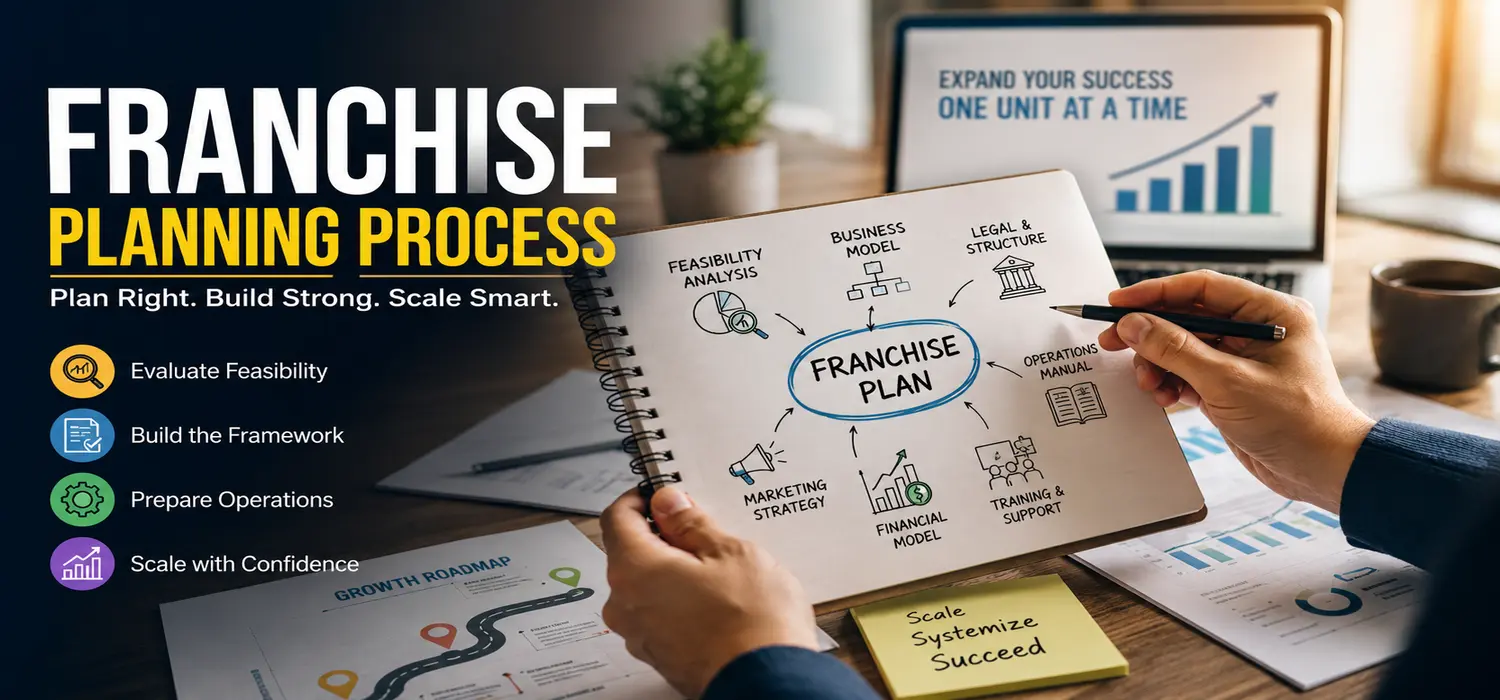
The franchise planning process is the structured preparation phase businesses go through before launching a franchise model.
It typically includes:
- franchise feasibility analysis
- operational standardization
- financial modeling
- legal structuring
- territory planning
- training system creation
- franchisee support design
- expansion strategy development
- unit economics validation
- leadership readiness assessment
In practical terms, franchise planning answers one question:
Can this business scale through independent operators without losing operational consistency, profitability, or brand reliability?
That sounds straightforward. It rarely is.
A business that performs well under founder supervision may struggle badly once locations are operated by franchisees with different skill levels, staffing quality, and market conditions.
Good franchise planning identifies those weaknesses before expansion begins.
A structured franchise strategy consulting guide can help founders prioritize expansion sequencing, operational readiness, and support infrastructure before franchise rollout begins.
Why Businesses Struggle During Franchise Expansion
Many founders underestimate how different franchise growth is from normal business growth.
Opening a second company-owned outlet is operational expansion. Franchising is systems expansion.
That distinction matters.
When a founder directly controls every decision, operational gaps stay hidden. Once franchisees enter the picture, those gaps become expensive.
Common breakdown points include:
| Operational Area | Typical Problem During Expansion |
|---|---|
| Training | Knowledge exists only in the founder’s head |
| Staffing | Hiring quality varies heavily by location |
| Inventory | Vendor inconsistency affects customer experience |
| Marketing | Franchisees execute branding differently |
| Financial Control | Unit profitability becomes unpredictable |
| Reporting | No centralized performance visibility |
| Customer Experience | Service standards drift over time |
| Operations | SOPs exist informally, not systematically |
This is why franchise consultants often spend more time fixing operational structure than discussing franchise sales.
A scalable franchise model is fundamentally an operational design problem.
Operational scaling challenges are also commonly discussed in broader small business growth frameworks published by organizations like the U.S. Small Business Administration (SBA), particularly around process standardization and expansion readiness.
The Real Objective of Franchise Planning
Many articles frame franchising as a fast-growth strategy.
That is incomplete.
The actual objective of franchise planning is controlled replication.
Growth without operational control creates:
- franchisee dissatisfaction
- legal disputes
- brand inconsistency
- unit closures
- support overload
- cash flow pressure
- founder burnout
The best franchise systems are not always the fastest-growing ones. Often, they are the businesses that scale slowly enough to maintain operational discipline.
Businesses evaluating long-term scalability often benefit from understanding broader business growth strategy through franchising approaches before accelerating expansion.
That tradeoff is rarely discussed openly.
Step-by-Step Franchise Planning Process
1. Evaluate Franchise Feasibility First
Before legal work, branding, or expansion discussions, businesses need a realistic franchise feasibility analysis.
This stage evaluates whether the business can replicate profitably across markets.
Key questions include:
Is the business operationally repeatable?
A founder-driven business is not automatically franchise-ready.
If daily operations rely heavily on:
- founder relationships
- personal supervision
- informal decision-making
- undocumented workflows
- specialized intuition
the model may not scale cleanly.
Franchise-ready businesses usually have:
- stable operational workflows
- repeatable customer delivery
- measurable performance standards
- manageable staffing requirements
- trainable systems
Are unit economics strong enough?
Healthy top-line revenue alone is not enough.
A franchise unit must generate:
- sustainable operating margins
- realistic payback periods
- reasonable labor ratios
- workable rent-to-revenue balance
- franchisee profitability after royalties
Many businesses skip this analysis and discover too late that franchisees cannot achieve viable returns.
That creates long-term network instability.
Can the business work in multiple locations?
Some businesses perform well only because:
- the founder is locally known
- the location is unusually strong
- labor costs are abnormally favorable
- demand conditions are unique
The franchise planning process must separate business strength from location luck.
Many businesses also study market benchmarks and franchise expansion trends through platforms like Franchise Direct before finalizing long-term franchise growth strategies.
This is a major reason why brands pursue detailed market analysis before scaling.
Related reading opportunities naturally connect here:
- franchise feasibility analysis
- business growth strategy through franchising
- franchise strategy consulting guide
2. Standardize Operations Before Expansion
This is where many businesses underestimate the workload.
Founders often assume:
“We already know how the business runs.”
But operational knowledge inside a founder’s head is not a scalable system.
Franchise expansion requires operational transferability.
That means converting informal execution into structured systems.
Core Operational Documentation Usually Includes
- standard operating procedures (SOPs)
- opening and closing checklists
- staffing workflows
- vendor processes
- customer handling standards
- escalation procedures
- inventory management systems
- quality control mechanisms
- reporting structures
The goal is not excessive documentation.
The goal is operational consistency without constant founder intervention.
Over-documentation can become a problem too. If manuals become too complex, franchisees stop using them.
Practical systems beat impressive-looking systems.
3. Build a Financial Franchise Model
One of the least understood parts of the franchise planning process is financial structure design.
Businesses often focus heavily on franchise fees while ignoring long-term network economics.
That creates problems later.
A franchise model must balance:
- franchisor profitability
- franchisee profitability
- support costs
- operational scalability
- growth sustainability
Financial Planning Typically Covers
| Financial Component | Why It Matters |
|---|---|
| Franchise Fee Structure | Impacts accessibility and revenue |
| Royalty Design | Affects long-term network sustainability |
| Marketing Contributions | Funds centralized growth activities |
| Franchisee Investment Estimates | Influences recruitment quality |
| Support Cost Modeling | Prevents operational overload |
| Break-even Analysis | Helps validate expansion viability |
Businesses planning structured expansion in India should also evaluate taxation, registration, and compliance obligations through official resources like the Ministry of Corporate Affairs (India)
Aggressive franchise fee structures sometimes attract the wrong operators.
Low-quality franchisees create operational problems that cost far more than short-term franchise sales revenue.
Strong franchise planning prioritizes network quality over fast expansion.
4. Create Training and Support Systems
Training is often treated as a launch requirement.
In reality, it becomes a permanent operational responsibility.
Many founders underestimate how much franchise support infrastructure is needed after onboarding.
Initial training alone does not maintain consistency.
Businesses need systems for:
- ongoing operational coaching
- quality audits
- marketing guidance
- performance monitoring
- software onboarding
- operational troubleshooting
- compliance management
This is where operational scaling complexity increases sharply.
A five-unit franchise network feels manageable.
A twenty-unit network creates:
- communication fragmentation
- support bottlenecks
- reporting overload
- inconsistent execution
- escalating management demands
The franchise planning process should account for future support realities, not just launch-stage excitement.
5. Develop the Legal and Structural Framework
Legal structuring is critical, but many businesses approach it too early.
Without operational clarity, legal documentation becomes theoretical rather than practical.
Once systems and economics are validated, businesses typically move toward:
- franchise disclosure documentation
- franchise agreements
- intellectual property protection
- trademark registration (Businesses should also ensure trademarks and brand assets are legally protected before expansion through official intellectual property registration systems such as the IP India Trademark Portal)
- compliance frameworks
- territory structures
- operational obligations
- brand usage policies
This stage should involve qualified franchise legal professionals.
Poor legal preparation creates major long-term risks.
However, overly restrictive agreements can also damage franchisee relationships and reduce expansion flexibility.
Good franchise systems balance control with operational practicality.
6. Define an Expansion Strategy
Not every franchise business should scale nationally immediately.
This is one of the biggest misconceptions in franchise development.
Rapid geographic expansion creates:
- support inefficiency
- inconsistent quality control
- travel overhead
- vendor complexity
- cultural adaptation challenges
A staged expansion strategy is often more sustainable.
Common Expansion Approaches
| Strategy | Best Fit |
|---|---|
| Local Cluster Expansion | Strong operational control |
| Regional Expansion | Moderate scaling pace |
| Statewide Growth | Requires stronger support infrastructure |
| Multi-City Expansion | Demands mature systems |
| National Franchising | Suitable only after operational stabilization |
Many experienced franchise consultants recommend tightening operational density before widening territory reach.
A concentrated franchise network is often easier to support and optimize.
7. Build Franchise Recruitment Criteria
Not every interested franchise buyer is a good fit.
This becomes painfully obvious later if recruitment standards are weak.
Businesses frequently focus too heavily on:
- investment capacity
- urgency to scale
- franchise sales volume
But long-term franchise performance often depends more on:
- operational discipline
- leadership ability
- process compliance
- communication quality
- local execution capability
A technically simple business can still fail under weak operators.
Strong franchise planning includes:
- franchisee qualification systems
- interview frameworks
- operational assessment criteria
- onboarding evaluation stages
- expectation management
Poor franchisee selection creates operational instability faster than almost any other expansion mistake.
Common Mistakes During the Franchise Planning Process
Expanding Before Systems Are Stable
Businesses often mistake demand for readiness.
A popular business is not automatically scalable.
If operational quality changes significantly between shifts, managers, or staffing conditions, franchising will amplify those inconsistencies.
Treating Franchising as Passive Income
Franchise networks require substantial operational involvement.
Support systems, compliance management, training, technology oversight, and franchisee communication create ongoing management complexity.
Franchising changes the nature of the business. It does not remove operational responsibility.
Building Around the Founder Instead of the System
This is extremely common in SMB businesses.
The founder becomes:
- head trainer
- problem solver
- operations manager
- marketing lead
- escalation point
That structure does not scale well.
Franchise planning should gradually reduce founder dependency.
Scaling Faster Than Support Capacity
A growing franchise network without proper support infrastructure creates frustration quickly.
Franchisees expect:
- guidance
- responsiveness
- operational clarity
- marketing assistance
- issue resolution
Growth without support damages franchise relationships and brand reputation.
Operational Realities Founders Often Overlook
Several hidden pressures emerge during franchise expansion.
Documentation Maintenance
Operational manuals are not “done” after launch.
They require:
- revisions
- updates
- compliance changes
- process improvements
- software adaptations
System maintenance becomes an ongoing workload.
Technology Standardization
As networks grow, fragmented tools create reporting problems.
Businesses eventually need:
- POS standardization
- centralized reporting
- CRM consistency
- inventory visibility
- marketing system alignment
Technology decisions made early can create major scaling friction later.
Middle Management Requirements
Founders often assume franchisees reduce operational oversight.
In reality, growing networks usually require:
- franchise managers
- support coordinators
- field operations staff
- training specialists
- compliance teams
The business structure itself evolves significantly.
This operational transition is a major reason consultants are frequently involved in helping businesses scale through structured franchise systems and repeatable operational frameworks.
When to Work With Franchise Consultants
Many founders wait too long before seeking franchise consulting support.
Usually because they assume consultants mainly help sell franchises.
In reality, experienced franchise consultants often provide the most value during the planning stage.
Businesses unfamiliar with franchise development often underestimate what a franchise consultant actually does beyond franchise sales support.
This includes:
- feasibility assessment
- operational structuring
- growth sequencing
- support model design
- financial planning
- expansion prioritization
- franchise readiness evaluation
This is one reason many scaling businesses eventually realize why businesses need franchise consulting before expanding aggressively.
For businesses entering franchising for the first time, external perspective helps identify blind spots internal teams may normalize.
This becomes especially important when:
- founders are heavily involved operationally
- systems are informal
- margins vary significantly
- staffing turnover is high
- expansion pressure is increasing
Related cluster topics naturally connect here:
- what does a franchise consultant do
- why businesses need franchise consulting
- franchise consulting services explained
- business expansion consultants in Chennai
A Practical Franchise Planning Mindset
The strongest franchise systems are rarely built around hype.
They are built around operational predictability.
That means:
- controlled processes
- measurable standards
- realistic growth pacing
- sustainable support structures
- disciplined expansion sequencing
Founders sometimes focus heavily on franchise sales because growth feels exciting.
But the real long-term asset is network stability.
A smaller, operationally healthy franchise system usually outperforms a rapidly expanded unstable network over time.
That perspective changes how businesses approach planning.
FAQs About the Franchise Planning Process
Conclusion
The franchise planning process is not simply a growth exercise.
It is a business transformation process.
A company moving from single-unit operations into franchising must rethink:
- operational structure
- leadership dependency
- financial modeling
- support systems
- training infrastructure
- expansion pacing
- performance visibility
The businesses that scale successfully through franchising usually treat preparation seriously long before franchise sales begin.
That preparation often determines whether growth becomes sustainable or chaotic.
Founders comparing advisory models should also understand how modern franchise consulting services are typically structured around operational planning, expansion support, and franchise system development.
For founders considering franchise expansion, the smartest next step is usually not aggressive scaling. It is gaining operational clarity first.
That includes understanding:
- whether the business is truly replicable
- where operational bottlenecks exist
- how scalable the support structure is
- what level of expansion the organization can realistically sustain
Businesses that solve those questions early tend to build healthier franchise systems later.
For region-specific scaling challenges, businesses also explore franchise expansion consulting in Tamil Nadu to better understand local operational, staffing, and expansion realities.