
Table of Contents
ToggleFranchise Operations Management Guide: Building Scalable Franchise Systems That Sustain Multi-Location Growth
Franchise growth is rarely limited by brand demand alone. In most cases, expansion slows because operational systems fail to scale consistently across multiple locations. This is where effective Franchise Operations Management becomes critical.
For business owners planning long-term expansion through franchising, operational management is not simply about monitoring outlets. It is the foundation that protects brand consistency, profitability, customer experience, compliance, and expansion velocity.
Brands that scale successfully through franchising usually share one characteristic: they build operational systems before aggressive expansion begins.
With over 26+ years of combined industry experience, 1500+ business consultations, and 210+ brands successfully franchised, Strategizer has consistently observed that operational readiness is one of the most underestimated components in franchise expansion strategy.
This guide explains how Franchise Operations Management works, why it matters for scalable growth, and how businesses can create structured operational systems capable of supporting long-term franchise expansion.
What Is Franchise Operations Management?
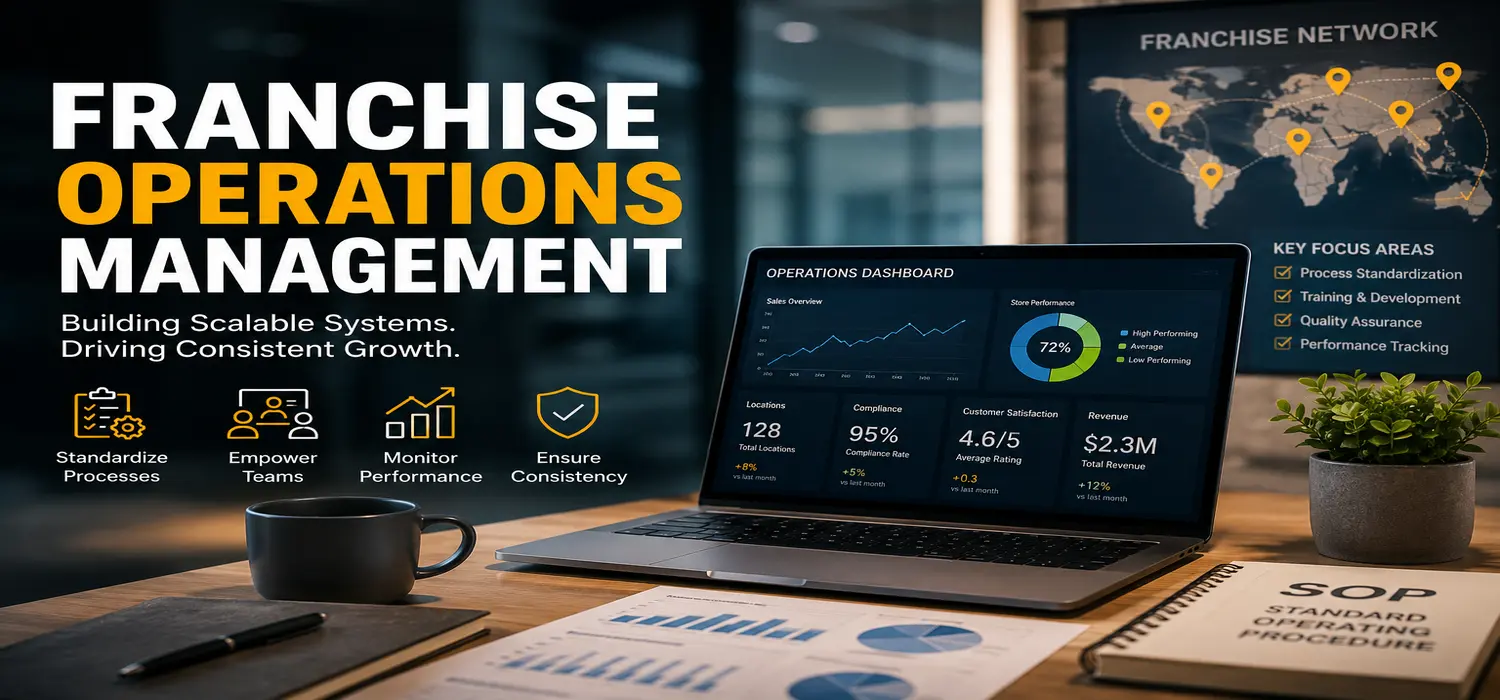
Franchise Operations Management refers to the systems, processes, controls, training structures, reporting mechanisms, and operational governance used to manage a franchise network efficiently across multiple locations.
It includes:
- Standard Operating Procedures (SOPs)
- Operational audits
- Franchisee onboarding systems
- Performance monitoring
- Brand compliance management
- Supply chain coordination
- Multi-location reporting structures
- Customer experience consistency
- Operational scalability planning
In simple terms, it is the operational backbone that allows a business to replicate successfully without losing control over brand standards.
Global franchise industry organizations like the International Franchise Association consistently emphasize operational standardization as a foundational requirement for scalable franchise growth.
Without structured franchise operations management, even strong brands often face:
- Inconsistent customer experiences
- Franchisee conflicts
- Operational inefficiencies
- Brand dilution
- Poor scalability
- Expansion instability
Why Franchise Operations Management Matters Before Expansion
Many business owners focus heavily on franchise sales while underestimating operational infrastructure.
However, sustainable franchising depends far more on operational replicability than initial expansion speed.
Businesses preparing for structured expansion often begin with understanding the broader framework of how to franchise your business in Chennai, where operational scalability becomes a critical part of long-term franchise readiness.
Operational Stability Drives Franchise Scalability
A franchise model only works when locations can operate consistently without depending entirely on the founder.
Strong Franchise Operations Management enables:
| Operational Area | Strategic Impact |
|---|---|
| SOP Standardization | Consistent execution across locations |
| Reporting Systems | Better decision-making visibility |
| Training Frameworks | Faster franchise onboarding |
| Compliance Controls | Brand protection |
| Performance Tracking | Scalable operational oversight |
| Technology Integration | Multi-location efficiency |
| Operational Audits | Early problem identification |
Businesses planning expansion should first evaluate whether their current systems can function predictably across multiple territories.
This is also why many brands exploring How to Franchise Your Business in Chennai begin by strengthening operational infrastructure before entering aggressive franchise development stages.
The Core Pillars of Franchise Operations Management
1. Standardized Operating Systems
The first requirement of scalable franchising is operational repeatability.
Every location should be capable of delivering:
- Similar service quality
- Similar customer experience
- Similar operational workflows
- Similar reporting accuracy
This requires detailed documentation covering:
- Daily operations
- Staff roles
- Inventory management
- Customer handling
- Quality control
- Vendor procedures
- Escalation workflows
Businesses researching the Franchise Documentation Process often realize that operational clarity significantly reduces future franchise management complexity.
Businesses exploring the franchise documentation process often discover that operational clarity significantly reduces future franchise management challenges.
2. Franchise Training and Onboarding
Even strong franchise models fail when onboarding lacks structure.
A scalable Franchise Operations Management system includes:
- Initial franchisee training
- Operational certification programs
- Location launch guidance
- Ongoing operational support
- Staff training modules
- Refresher systems
Training should not depend on verbal communication alone.
High-growth franchise brands rely on:
- Training manuals
- Video SOP libraries
- LMS platforms
- Operational playbooks
- Role-specific workflows
This becomes increasingly important in industries where operational execution directly affects customer trust.
In Short: What Makes Franchise Operations Scalable?
A scalable franchise system usually includes:
- Documented SOPs
- Centralized operational visibility
- Performance benchmarks
- Multi-location reporting
- Consistent customer experience controls
- Technology-supported operations
- Franchisee accountability systems
- Structured support mechanisms
Without these systems, rapid expansion often creates operational instability rather than sustainable growth.
Technology’s Role in Franchise Operations Management
Modern Franchise Operations Management increasingly depends on centralized technology ecosystems.
Franchise networks today require visibility across:
- Sales reporting
- Inventory movement
- Staff productivity
- Customer feedback
- Operational compliance
- Financial performance
Technology enables franchisors to monitor operational consistency without relying entirely on manual oversight.
Businesses researching how to scale a business through franchising often underestimate how essential centralized operational visibility becomes as franchise networks grow.
Operational consulting firms such as McKinsey & Company have extensively documented how centralized reporting and process visibility improve multi-location business performance.
Common Operational Technologies Used in Franchise Systems
| System Type | Operational Benefit |
|---|---|
| POS Integration | Centralized Revenue Tracking |
| CRM Systems | Customer Relationship Consistency |
| Audit Platforms | Compliance Monitoring |
| LMS Platforms | Franchise Training Scalability |
| ERP Systems | Multi-location Coordination |
| BI Dashboards | Executive-level Reporting Insights |
Businesses exploring How to Scale a Business Through Franchising often underestimate how critical operational visibility becomes once the network expands beyond a few locations.
Common Franchise Operations Challenges Businesses Face
Even established brands experience operational friction during expansion.
Inconsistent Location Performance
Different franchisees may interpret systems differently if operational documentation lacks clarity.
Weak Compliance Monitoring
Without structured audits, operational quality often declines gradually across locations.
Founder Dependency
If operations rely excessively on founder involvement, scalability becomes restricted.
Poor Communication Systems
Multi-location businesses require structured communication channels to prevent operational confusion.
Lack of KPI Tracking
Without measurable performance indicators, identifying operational inefficiencies becomes difficult.
These issues are commonly addressed during the Franchise Development Process Explained phase when businesses move from concept-level franchising to structured system development.
Building an Effective Franchise Operations Framework
A practical Franchise Operations Management framework usually develops in stages.
Phase 1: Operational Assessment
Evaluate current business operations:
- Can systems be replicated?
- Are workflows standardized?
- Is customer experience consistent?
- Are operational bottlenecks documented?
Phase 2: SOP Development
Create operational documentation for:
- Front-end operations
- Back-end management
- Vendor coordination
- Staff management
- Escalation protocols
- Quality standards
This stage is closely connected to SOP development for franchise businesses, where brands convert founder-driven operations into scalable execution systems.
Businesses often combine this phase with SOP Development for Franchise Businesses to create scalable operational foundations.
Phase 3: Operational Governance
Establish:
- Reporting hierarchies
- Operational KPIs
- Audit schedules
- Compliance systems
- Franchise support structures
Phase 4: Technology Integration
Implement systems that centralize operational visibility across all franchise units.
Phase 5: Continuous Improvement
Operational management is never static.
Strong franchise systems continuously optimize:
- Customer experience
- Operational efficiency
- Training frameworks
- Franchisee support
- Reporting accuracy
Strategic Insight: Expansion Without Operations Is High-Risk Growth
One of the most common mistakes businesses make is prioritizing franchise sales before operational maturity.
Sustainable franchise expansion depends on operational control, not just market demand.
Research published by Harvard Business Review has repeatedly highlighted that scalable businesses rely heavily on repeatable operational systems rather than founder-dependent execution models.
Brands that scale successfully usually expand slower initially but build stronger systems early.
This is why long-term franchise expansion strategy for businesses must prioritize operational consistency before aggressive outlet growth.
This is particularly important for businesses evaluating long-term Franchise Expansion Strategy for Businesses rather than short-term outlet growth.
Franchise Operations Management and Brand Protection
Every franchise location directly influences brand perception.
Weak operations in one unit can affect the credibility of the entire franchise network.
Effective Franchise Operations Management protects brand value through:
- Operational consistency
- Quality assurance systems
- Customer experience controls
- Staff accountability
- Brand compliance monitoring
This becomes increasingly important as brands enter multiple cities, regions, or operational territories.
When Should Businesses Invest in Franchise Operations Systems?
Businesses should strengthen operational systems before:
- Launching franchise sales
- Expanding into multiple cities
- Scaling aggressively
- Entering regional franchise markets
- Building master franchise structures
Companies often wait too long to operationalize systems, which increases restructuring costs later.
Brands evaluating How to Create a Franchise System should prioritize operational management as a foundational component rather than an afterthought.
How Strategizer Approaches Franchise Operations Management
Strategizer works with businesses that want structured, scalable franchise expansion systems rather than short-term franchise selling models.
The consulting approach focuses on:
- Operational scalability
- SOP architecture
- Multi-location management systems
- Franchise governance frameworks
- Expansion-readiness assessment
- Operational consistency planning
Because franchise growth affects every aspect of a business model, operational management is treated as a strategic expansion function rather than a support activity.
Businesses exploring guidance from Franchise Consultants in Chennai often require not just franchise documentation, but operational systems capable of sustaining long-term network growth.
Key Takeaways for Business Owners
Effective Franchise Operations Management Helps Businesses:
- Scale without losing operational control
- Maintain consistent customer experiences
- Improve franchisee performance
- Protect brand reputation
- Build sustainable expansion systems
- Reduce operational inefficiencies
- Strengthen long-term scalability
Businesses Should Avoid:
- Expanding before operational standardization
- Relying excessively on founder oversight
- Operating without measurable KPIs
- Delaying SOP development
- Ignoring operational governance structures
Franchise Operations FAQs
What is franchise operations? +
What is the difference between FOCO and FOFO? +
What are the 4 P's of franchising? +
What are the 5 stages of franchise enlargement? +
How do SOPs support franchise operations? +
Conclusion
Franchising is ultimately an operational scalability model.
While branding, marketing, and expansion strategies are important, long-term franchise success depends heavily on operational structure and system consistency.
Businesses that invest early in Franchise Operations Management are typically better positioned to scale sustainably, maintain brand quality, and support long-term franchise network growth.
For founders planning structured expansion, operational management should be viewed not as an administrative process, but as a core strategic asset that determines whether franchise growth becomes scalable or unstable.