
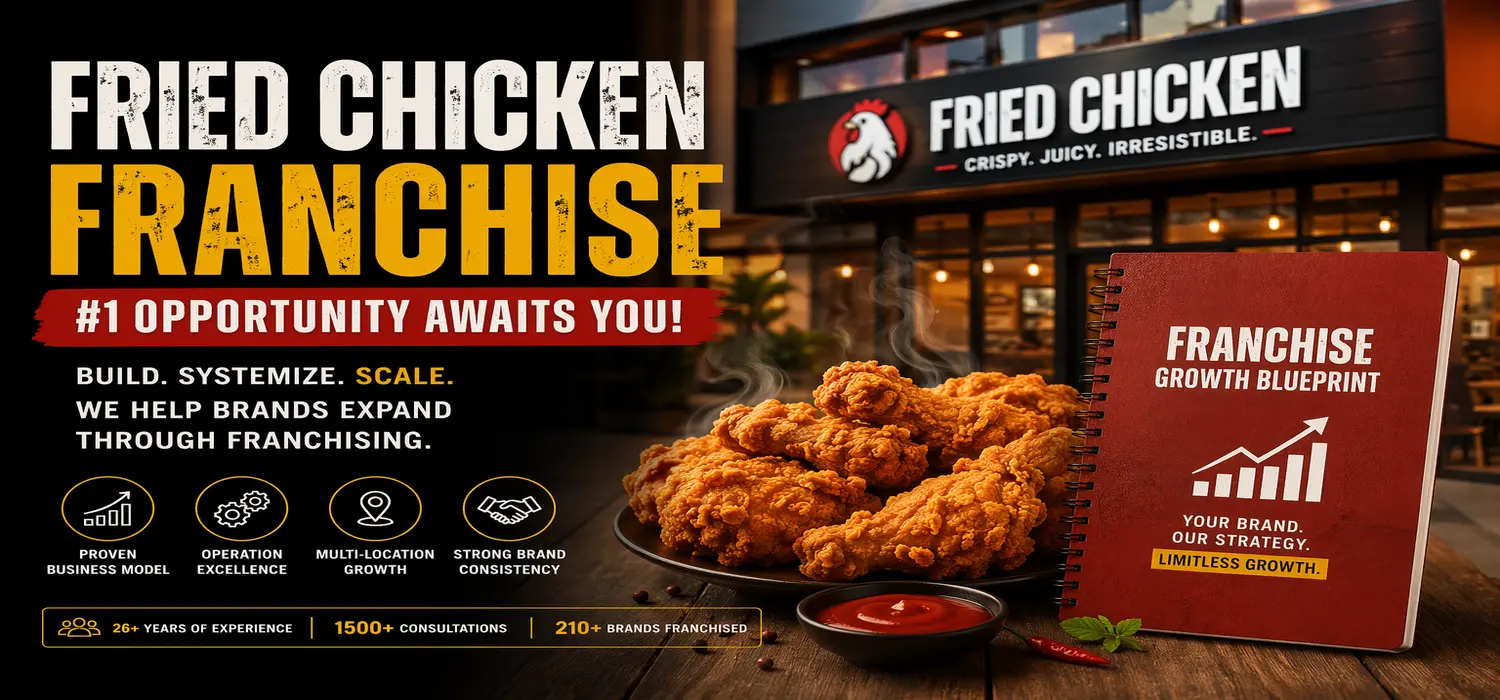
Fried Chicken Franchise: Strategic Brand Expansion Blueprint for Scalable Growth
The fried chicken franchise model has evolved far beyond a simple replication of outlets. Today, it represents one of the most structured, system-driven expansion frameworks for food brands aiming to scale across cities, regions, and global markets.
For business owners, the question is no longer “Should we expand?” it’s “How do we scale without breaking operations, brand consistency, or profitability?”
This is where franchising becomes a strategic lever not a shortcut.
At Strategizer, with over 26+ years of combined industry experience, 1500+ business consultations, and 210+ brands successfully franchised, the focus has always been clear building scalable systems for growth through a structured franchise development strategy.
This page is not about buying a franchise.
This is about building one that scales.
Start With a Strategic Expansion Lens
If you’re running a fried chicken brand and considering expansion, the real question is:
Do you have a replicable system, or just a successful outlet?
If you’re unsure, it’s time to structure your expansion roadmap.
Fried Chicken Franchise Expansion Snapshot
Expansion Model: Franchise-led multi-location growth
Scalability Potential: Very High (if systemized correctly)
Operational Complexity: Medium to High
Brand Control Requirement: Critical
Best Suited For:
- Established QSR brands
- Strong product-market fit businesses
- Brands with consistent unit economics
What is a Fried Chicken Franchise (From a Business Expansion Perspective)?
A fried chicken franchise is not just about licensing recipes or brand names. From a strategic standpoint, it is:
A system replication model
A distribution strategy for brand reach
A scaling mechanism through decentralized operations
A fried chicken franchise is essentially a structured model for multi-location business expansion, where systems, branding, and operations are replicated across markets.
Key Components of a Scalable Franchise Model
1. Product Standardization
Your fried chicken recipe must deliver the same taste across locations regardless of operator.
- Defined cooking processes
- Ingredient sourcing control
- Kitchen SOPs
2. Operational Systems
Expansion fails when operations depend on individuals instead of systems.
- Staff training modules
- Kitchen workflows
- Service time benchmarks
3. Brand Consistency
Customers should not feel a difference between outlets.
- Store design guidelines
- Packaging standards
- Customer experience protocols
4. Unit Economics Stability
Before scaling, each outlet must be:
- Predictable in performance
- Operationally sustainable
- Efficient in cost structure
In Short:
A fried chicken franchise is a business system productized for expansion, not just a food concept.
Market & Expansion Insights: Why Fried Chicken Brands Scale Fast
The fried chicken segment has become one of the most scalable categories in the QSR ecosystem due to:
1. High Repeat Consumption
Fried chicken is a habit-driven product category.
- Works across demographics
- Strong delivery + dine-in hybrid demand
- High frequency consumption
2. Operational Repeatability
Compared to complex cuisines:
- Limited menu complexity
- Faster training cycles
- Easier SOP implementation
3. Strong Brand Differentiation Potential
Brands can stand out through:
- Signature flavors
- Regional adaptations
- Unique branding
Fried chicken brands are growing rapidly as part of the global QSR expansion trend, with structured scaling models driving multi-location growth. According to National Restaurant Association, the restaurant industry continues to see strong demand in quick-service categories.
| Expansion Model | Scalability | Control | Speed | Risk Level |
|---|---|---|---|---|
| Company-Owned Growth | Medium | High | Slow | Medium |
| Franchise Model | High | Medium | Fast | Medium |
| Licensing | High | Low | Fast | High |
| Joint Ventures | Medium | Medium | Medium | Medium |
Insight: Franchising offers the best balance between speed and control when structured correctly.
Franchising continues to be one of the most structured and scalable expansion approaches globally, as highlighted by International Franchise Association, especially for brands aiming to scale without losing operational control.
Why Most Food Brands Fail at Scaling
Many fried chicken brands succeed at a single outlet but fail during expansion due to:
- Lack of process documentation
- Dependency on founders
- Inconsistent supply chain
- Poor franchise partner selection
- No structured training system
Core Problem:
They try to scale a business, not a system.
Services: How Strategic Franchise Development Actually Works
A successful fried chicken franchise is not built by copying outlets it is engineered through structured consulting.
1. Business Expansion Consulting
This phase evaluates:
- Scalability of current model
- Operational gaps
- Brand positioning
This phase evaluates your business readiness and aligns with a structured business expansion consulting approach to ensure scalability.
2. Franchise Model Structuring
Includes:
- Franchise format design
- Revenue model alignment
- Territory structuring
3. SOP & System Development
Critical for consistency:
- Kitchen operations manual
- Staff training frameworks
- Quality control systems
Operational standardization is what separates scalable brands from struggling ones, and global systems like McDonald’s demonstrate how process-driven execution enables consistent multi-location expansion.
4. Franchise Rollout Strategy
Focuses on:
- Market prioritization
- Expansion phasing
- Growth pacing
| Stage | Objective | Outcome |
|---|---|---|
| Audit & Analysis | Identify scalability gaps | Clear expansion roadmap |
| Model Structuring | Build franchise framework | Standardized model |
| SOP Development | Systemize operations | Consistency across units |
| Pilot Testing | Validate replication | Risk reduction |
| Rollout Strategy | Controlled expansion | Sustainable growth |
Process: How Strategizer Builds Scalable Franchise Systems
Step 1: Business Scalability Audit
- Unit economics validation
- Process dependency mapping
- Brand readiness assessment
Step 2: Expansion Blueprint Design
- Franchise structure
- Revenue model
- Operational framework
Step 3: SOP & Documentation
- Detailed operational manuals
- Training modules
- Quality benchmarks
Step 4: Pilot Expansion
- Controlled rollout
- Real-world validation
- System refinement
Step 5: Scaled Rollout
- Territory-based expansion
- Controlled partner onboarding
- Continuous monitoring
Case Study: Scaling a Regional Fried Chicken Brand
Problem
A regional fried chicken brand had:
- Strong single outlet performance
- High customer demand
- No scalable systems
Strategy
- Built standardized kitchen processes
- Designed franchise model
- Created training systems
- Implemented phased expansion
Outcome
- Multi-location presence within 18 months
- Consistent product quality
- Reduced operational dependency on founders
Many high-growth fried chicken brands have followed structured expansion models similar to KFC, where standardized processes and brand consistency enabled rapid multi-location scaling.
Strategic Advisory: What Separates Scalable Brands from Non-Scalable Ones
Scalable Brands Have:
Documented systems
Predictable unit economics
Strong brand identity
Training infrastructure
Non-Scalable Brands Have:
Founder-dependent operations
No SOPs
Inconsistent customer experience
Weak brand positioning
Common Mistakes Brands Make While Expanding
1. Expanding Without Systems
Leads to inconsistency and brand damage.
2. Ignoring Unit Economics
Scaling losses is faster than scaling profits.
3. Poor Partner Structuring
Wrong partners can destroy brand reputation.
4. No Training Infrastructure
Results in operational chaos.
5. Overexpansion
Growth without control leads to collapse.
Research consistently shows that businesses scale successfully only when operations are systemized and leadership dependency is reduced, as discussed by Harvard Business Review in multiple growth strategy studies.
| Business Factor | Ready for Franchising? |
|---|---|
| Consistent Sales | Yes |
| Standardized Operations | Yes |
| Strong Brand Identity | Yes |
| Founder Dependency | No |
| SOP Documentation | Yes |
Franchise Readiness Checklist
- Do you have repeatable operations?
- Can a new team replicate your kitchen?
- Is your brand experience consistent?
- Are your margins stable?
If 3+ answers are “No”, you need structuring before scaling.
Before making a scaling decision, it’s important to follow a structured restaurant growth strategy framework to evaluate readiness and long-term sustainability.
Why Strategic Execution Matters
Franchise success is not about opportunity it’s about execution.
With:
- 26+ years of combined expertise
- 1500+ business consultations
- 210+ successfully franchised brands
Strategizer focuses on:
Building scalable systems
Reducing expansion risks
Ensuring long-term brand sustainability
Build Your Expansion Strategy
If you’re serious about scaling your fried chicken brand:
Start with a structured expansion strategy
Identify your scalability gaps
Build a franchise system that works
Turn Your Fried Chicken Brand Into a Scalable Franchise System
You don’t need more outlets.
You need a replicable, controlled, and scalable expansion system.
Most fried chicken brands reach a ceiling not because of demand
but because their operations are not designed to scale.
Here’s the Reality Most Founders Realize Too Late
- Growth without systems leads to brand inconsistency
- Expansion without structure leads to operational breakdown
- Franchising without strategy leads to loss of control
Scaling is not about opening more stores.
It’s about building a business that can be replicated without you.
What Happens When You Get It Right?
When your franchise system is structured correctly:
Every outlet delivers the same customer experience
Your brand grows without operational chaos
Expansion becomes predictable, not risky
You move from “running outlets” to “building a brand network”
This Is Where Strategizer Comes In
With 26+ years of combined experience,
1500+ business consultations,
and 210+ brands successfully franchised,
Strategizer helps you:
- Convert your business into a scalable franchise model
- Build SOP-driven operations that work across locations
- Design a controlled expansion roadmap
- Avoid costly mistakes most brands make during scaling
Before You Expand, Ask Yourself This:
- Can your business run without your daily involvement?
- Can a new outlet deliver the same quality without you?
- Do you have systems or just experience?
If these answers are unclear,
Expansion without strategy will cost you more than it gives.
Your Next Step (High-Impact Move)
Instead of guessing your expansion path,
take a structured approach:
Get clarity on your brand’s scalability
Identify gaps in your current model
Build a franchise-ready system
Book a Strategic Expansion Discussion
This is not a sales call.
This is a deep-dive business evaluation where you will:
- Understand if your brand is ready for franchising
- Identify what’s stopping you from scaling
- Get a clear expansion direction
If You’re Serious About Scaling
Don’t wait until:
- Operations become unmanageable
- Brand consistency starts breaking
- Expansion mistakes become expensive
The earlier you structure your franchise system,
the faster and safer you scale.
Final Thought
Every successful fried chicken chain you see today
did not grow by chance.
They grew because they built:
Systems
Structure
Scalability
Your Brand Can Do the Same If You Build It Right
Start with strategy.
Build with structure.
Scale with control.
That’s how real expansion works.