
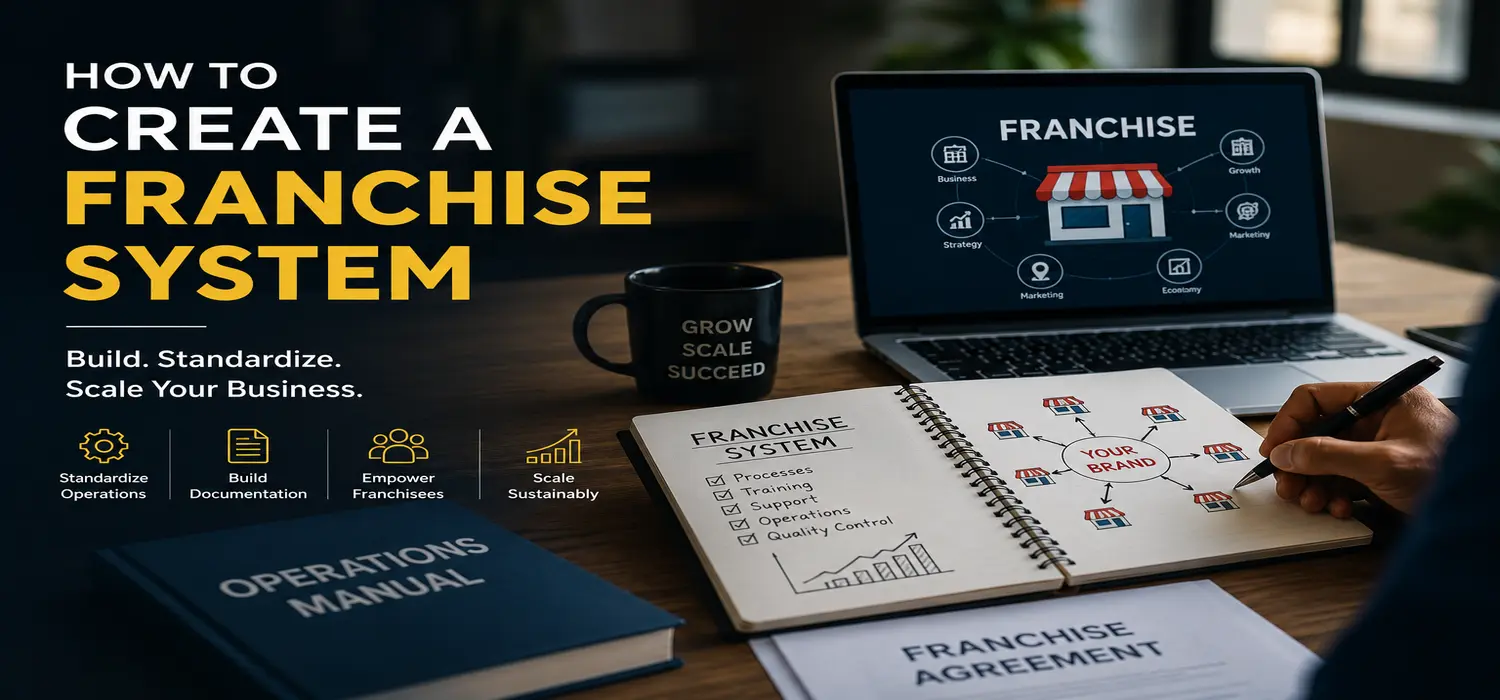
Table of Contents
ToggleHow to Create a Franchise System: A Strategic Guide for Business Expansion
Expanding beyond a single successful location is one of the most critical growth decisions a business owner can make. For many brands, franchising becomes the bridge between operational success and scalable market expansion. But understanding how to create a franchise system requires far more than drafting agreements or selling territories.
A successful franchise structure is built on operational consistency, financial viability, legal compliance, replicable systems, and long-term brand governance.
At Strategizer, franchise consultants work closely with growing brands to transform owner-dependent businesses into scalable franchise-ready systems. With 26+ years of combined industry experience, 1500+ business consultations, and 210+ brands successfully franchised, the firm has observed a common reality: businesses fail in franchising not because the concept is weak, but because the franchise system itself was never strategically engineered.
This guide explains how to create a franchise system that supports sustainable multi-location growth while protecting brand consistency and operational scalability.
What Is a Franchise System?
A franchise system is the complete operational, legal, financial, and management framework that allows a business to replicate successfully across multiple locations under standardized brand guidelines.
It includes:
- Brand standards
- Operating procedures
- Training systems
- Franchise documentation
- Financial models
- Territory structures
- Quality control systems
- Franchise support mechanisms
- Expansion governance
Businesses researching franchise expansion frameworks often refer to standards and educational resources published by the International Franchise Association to better understand global franchising structures and operational models.
In short, understanding how to create a franchise system means building a business model that can operate consistently without constant founder involvement.
In Short
A franchise is not merely a licensing arrangement. It is a structured expansion ecosystem designed for controlled growth, operational repeatability, and long-term scalability.
Why Businesses Need a Structured Franchise System
Many businesses attempt expansion before standardizing operations. This often creates inconsistent customer experiences, franchise disputes, weak unit economics, and brand dilution.
A professionally developed franchise system helps businesses:
Business scalability experts frequently emphasize that sustainable expansion depends on operational standardization, leadership systems, and replicable business processes concepts regularly discussed by Forbes in growth and business strategy publications.
Businesses planning regional expansion often begin with a broader roadmap on how to franchise your business in Chennai before developing operational franchise systems.
| Business Objective | Strategic Impact |
|---|---|
| Multi-location Expansion | Faster Geographic Growth |
| Operational Consistency | Standardized Customer Experience |
| Reduced Founder Dependency | Scalable Management Structure |
| Brand Protection | Controlled Execution Across Locations |
| Revenue Diversification | Franchise Fees + Recurring Royalties |
| Expansion Efficiency | Lower Capital Burden Compared to Company-Owned Growth |
Business owners researching how to create a franchise system often underestimate the importance of operational architecture. A scalable franchise brand is built on systems, not assumptions.
Step 1: Evaluate Franchise Readiness
Before developing a franchise structure, businesses must assess whether the model is actually replicable.
Core Franchise Readiness Indicators
Proven Business Model
The business should already demonstrate:
- Stable revenue patterns
- Market demand
- Repeat customers
- Operational consistency
- Positive unit economics
Business scalability, operational consistency, and financial readiness are also commonly emphasized in business growth frameworks published by the U.S. Small Business Administration
Replicable Operations
If success depends entirely on the founder’s personal involvement, franchising becomes risky.
Brand Positioning
Strong franchise brands typically have:
- Clear market differentiation
- Defined customer identity
- Consistent brand communication
- Standardized service delivery
Scalability Potential
Businesses should evaluate:
- Regional expansion demand
- Operational adaptability
- Supply chain scalability
- Training complexity
Brands exploring how to create a franchise system often benefit from conducting a structured franchise feasibility assessment before entering development.
For deeper expansion planning, businesses often explore related frameworks like:
- “Franchise Business Model for Brand Owners”
- “How to Scale a Business Through Franchising”
- “Franchise Expansion Strategy for Businesses”
These supporting topics help build a broader strategic foundation for expansion readiness.
Step 2: Standardize Operations Before Franchising
One of the most important stages in how to create a franchise system is operational standardization.
Franchise systems fail when processes exist only in the founder’s mind.
Operational Areas That Must Be Standardized
Daily Operations
- Opening and closing procedures
- Staff responsibilities
- Customer handling processes
- Inventory systems
Brand Standards
- Visual identity
- Customer experience guidelines
- Store layout consistency
- Service protocols
Vendor & Supply Chain Systems
- Approved supplier structures
- Procurement guidelines
- Logistics processes
Financial Procedures
- Reporting formats
- Revenue tracking
- Royalty systems
- Compliance mechanisms
This is where structured SOP development for franchise businesses becomes essential for maintaining operational consistency across multiple locations. Businesses often require dedicated work around “SOP Development for Franchise Businesses” to ensure operational repeatability.
Strategic Insight
Franchising scales systems not chaos. The stronger the operational documentation, the easier it becomes to maintain consistency across locations.
Step 3: Develop the Franchise Business Model
A franchise model must align commercial viability for both the franchisor and franchisee.
Businesses evaluating long-term scalability should also understand how a structured franchise business model for brand owners impacts operational sustainability and expansion efficiency.
When businesses ask how to create a franchise system, they often focus heavily on franchise fees while ignoring long-term operational sustainability.
Key Franchise Model Components
Franchise Fee Structure
The initial fee should reflect:
- Brand value
- Market demand
- Training investment
- Launch support
Royalty Model
Royalty structures may include:
- Revenue percentage
- Fixed royalty
- Hybrid structures
Territory Strategy
Define:
- Exclusive territories
- Market saturation policies
- Expansion rights
Unit Economics
A scalable franchise model requires:
- Healthy margins
- Reasonable payback periods
- Sustainable operational costs
Many business owners also study franchise growth trends, scalability models, and operational benchmarks through industry resources published by Entrepreneur Franchise
Support Framework
The franchise system should define:
- Training support
- Marketing assistance
- Operational audits
- Technology systems
Businesses often compare franchising with company-owned expansion before deciding the best growth structure. Strategic evaluation is critical before system development begins.
Step 4: Create Franchise Documentation
Documentation forms the legal and operational backbone of a franchise network.
Businesses entering structured expansion often require a dedicated understanding of the franchise documentation process to ensure operational clarity and legal consistency.
| Document | Purpose |
|---|---|
| Franchise Agreement | Defines franchisor-franchisee relationship |
| Franchise Disclosure Documents | Provides legal and operational transparency |
| Operations Manual | Standardizes business execution |
| Training Manuals | Supports onboarding consistency |
| Brand Guidelines | Protects visual and customer identity |
| Territory Policies | Defines geographic rights |
A major mistake businesses make while learning how to create a franchise system is treating documentation as a legal formality instead of an operational control mechanism.
Strong documentation reduces:
- Operational ambiguity
- Franchise conflicts
- Brand inconsistency
- Compliance risk
Businesses frequently require dedicated guidance around the “Franchise Documentation Process” to ensure proper legal and operational structuring.
Step 5: Build Franchise Training & Support Systems
Franchisees cannot succeed without structured onboarding and continuous operational support.
Effective Franchise Support Includes
Initial Training
- Operations training
- Sales systems
- Technology onboarding
- Customer service standards
Launch Support
- Site setup assistance
- Recruitment guidance
- Marketing launch planning
Ongoing Support
- Performance reviews
- Operational audits
- Marketing coordination
- Business coaching
When evaluating how to create a franchise system, businesses should remember that franchisees are not merely operators — they are long-term brand partners.
Step 6: Establish Franchise Operations Management
Franchise growth without governance eventually creates inconsistency.
Businesses managing multi-location scalability often implement systems discussed in this franchise operations management guide to maintain operational control and performance visibility.
This is why mature brands prioritize franchise operations management early.
Critical Franchise Management Areas
Performance Monitoring
Track:
- Revenue benchmarks
- Customer satisfaction
- Operational compliance
- Audit performance
Technology Integration
Modern franchise systems rely heavily on:
- CRM platforms
- POS integrations
- Reporting dashboards
- Franchise management software
Brand Protection
Consistency requires:
- Mystery audits
- Compliance reviews
- Brand monitoring
Businesses scaling through franchising often explore dedicated operational frameworks like the “Franchise Operations Management Guide” to improve network stability.
Common Mistakes When Creating a Franchise System
Businesses researching how to create a franchise system should avoid these common expansion mistakes.
Many scaling brands also review detailed insights on common mistakes when franchising your business before launching expansion programs.
1. Franchising Too Early
Expanding before operational maturity creates instability.
2. Weak Documentation
Poorly documented systems lead to inconsistent execution.
3. Founder Dependency
If operations depend entirely on the founder, scalability becomes limited.
4. Aggressive Expansion
Rapid territory sales without support infrastructure damages brand quality.
5. Ignoring Franchisee Support
Franchisees require ongoing operational guidance to sustain growth.
Many scaling businesses revisit strategic lessons from “Common Mistakes When Franchising Your Business” before launching expansion programs.
How Strategizer Helps Businesses Build Franchise Systems
Creating a scalable franchise structure requires both strategic and operational expertise.
Strategizer supports brands through:
- Franchise readiness analysis
- Franchise business model development
- SOP and operations structuring
- Franchise documentation coordination
- Expansion strategy consulting
- Franchise operations frameworks
- Multi-location growth planning
The consulting approach focuses on building sustainable franchise ecosystems rather than short-term expansion campaigns.
Businesses searching for “Franchise Consultants in Chennai” often prioritize advisory partners with operational understanding, not just documentation expertise. That distinction significantly impacts long-term franchise success.
Strategic Takeaway: Franchising Is a Systems Business
Understanding how to create a franchise system ultimately means understanding scalable operational architecture.
The most successful franchise brands are not necessarily the largest brands initially. They are the brands that:
- Standardize early
- Build repeatable systems
- Protect operational consistency
- Support franchise partners effectively
- Scale strategically rather than aggressively
Franchise growth succeeds when expansion is engineered not improvised.
Global franchise ecosystems increasingly emphasize structured governance, operational consistency, and ethical expansion standards, principles also supported by organizations like the World Franchise Council
FAQs
How long does it take to create a franchise system?
What is the first step in how to create a franchise system?
Do all businesses qualify for franchising?
Why are SOPs important in a franchise system?
Can small businesses create franchise systems?
Conclusion
Businesses exploring how to create a franchise system should approach franchising as a long-term business infrastructure project rather than a simple expansion tactic.
A strong franchise system combines:
- Operational discipline
- Strategic growth planning
- Documentation clarity
- Brand governance
- Franchise support systems
Done correctly, franchising becomes one of the most efficient pathways for sustainable multi-location business expansion.
For brands preparing for scalable growth, structured franchise consulting can significantly reduce expansion risks while improving operational readiness and long-term franchise stability.