
Table of Contents
ToggleHow to Scale a Business Through Franchising: A Strategic Growth Framework for Brand Owners
Businesses that expand successfully across multiple locations rarely grow through improvisation alone. Sustainable expansion requires operational systems, brand consistency, leadership scalability, and a replicable commercial model. That is exactly why many established businesses choose to scale a business through franchising rather than relying only on company-owned expansion.
For founders and business owners, franchising is not simply about selling franchise rights. It is about transforming a business into a scalable operating system capable of expanding across regions without losing control, quality, or profitability.
Businesses exploring regional expansion models often begin by understanding the broader framework behind how to franchise your business in Chennai before developing large-scale multi-location systems.
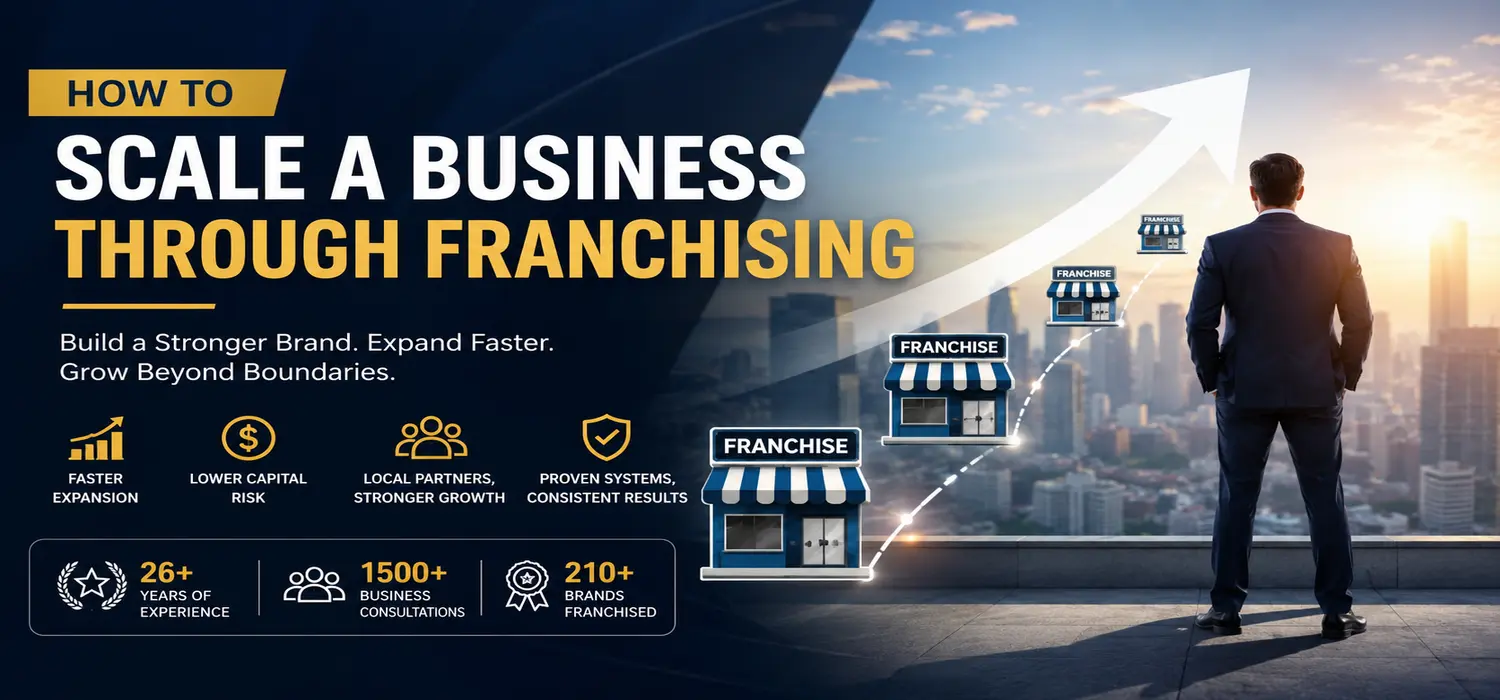
At Strategizer, the consulting team has worked with brands across multiple industries to develop structured expansion systems. With 26+ years of combined experience, over 1500+ business consultations, and 210+ brands successfully franchised, the firm has seen a consistent pattern: businesses that scale successfully through franchising are the ones that build operational clarity before expansion begins.
What Does It Mean to Scale a Business Through Franchising?
To scale a business through franchising, a company creates a structured business model that allows independent operators to replicate the brand using standardized systems, processes, training, and operational guidelines.
Instead of opening every new branch with internal capital and management, the franchisor enables qualified operators to run branded locations under a controlled framework.
This approach helps businesses:
- Expand faster into new markets
- Reduce capital burden
- Increase geographic presence
- Build recurring royalty revenue
- Standardize customer experience
- Accelerate multi-location growth
However, franchising only works when the business is operationally ready for replication.
Why More Businesses Are Choosing to Scale Through Franchising
Traditional expansion models often create operational bottlenecks. A founder can successfully manage one or two locations personally, but scaling beyond that becomes increasingly complex.
Businesses that attempt aggressive expansion without systems often face:
- Quality inconsistency
- Leadership dependency
- Rising operational costs
- Staff management issues
- Brand dilution
- Slow regional execution
This is where franchising becomes a strategic growth mechanism.
When businesses scale a business through franchising, they leverage local operators who are financially and operationally invested in the success of each location.
| Expansion Area | Company-Owned Growth | Franchise Expansion |
|---|---|---|
| Capital Requirement | High | Lower |
| Speed of Expansion | Moderate | Faster |
| Local Market Execution | Centrally Controlled | Locally Driven |
| Operational Responsibility | Internal | Shared |
| Geographic Scalability | Limited by Resources | Highly Scalable |
| Revenue Structure | Direct Sales Only | Royalties + Fees |
For many founders, franchising becomes the bridge between a successful local business and a scalable regional or national brand.
According to the International Franchise Association, structured franchise systems continue to play a major role in multi-location business expansion across industries, particularly for brands seeking scalable growth models and operational standardization.
Is Your Business Ready to Scale Through Franchising?
Not every successful business is franchise-ready.
A business may be profitable but still operationally dependent on the founder. In such cases, replication becomes risky.
Before you scale a business through franchising, evaluate whether the brand has:
1. A Proven Business Model
The business should already demonstrate:
- Stable customer demand
- Repeatable revenue patterns
- Strong unit economics
- Operational consistency
Franchisees invest in predictability, not experimentation.
2. Standardized Operations
If every branch operates differently, franchise expansion becomes difficult.
This is why structured systems such as:
- SOPs (SOP Development for Franchise Businesses)
- training frameworks
- onboarding systems
- quality controls
- inventory standards
- brand guidelines
are critical before expansion.
Businesses exploring operational standardization often benefit from resources related to:
- “SOP Development for Franchise Businesses”
- “How to Create a Franchise System”
- “Franchise Operations Management Guide”
These frameworks create the foundation required to scale a business through franchising effectively.
3. Brand Replicability
A franchise model works only when the customer experience can be repeated across locations.
Ask:
- Can another operator deliver the same experience?
- Is the business too founder-dependent?
- Can training replace founder supervision?
- Is operational knowledge documented?
4. Market Scalability
Businesses with strong local demand may still struggle nationally if the model lacks adaptability.
Successful franchise brands usually have:
- Regional market flexibility
- Broad consumer relevance
- Efficient supply systems
- Strong operational margins
The Franchise Expansion Framework Used by Scalable Brands
Businesses that successfully scale a business through franchising usually follow a phased expansion framework rather than rushing into rapid territory sales.
Phase 1: Business Structuring
This stage focuses on preparing the business for replication.
Key priorities include:
- Operational documentation
- Unit economics analysis
- Profitability assessment
- Brand positioning
- Scalability analysis
- Expansion feasibility
This stage is closely connected to the broader “Franchise Development Process Explained” methodology.
Phase 2: Franchise Model Development
At this stage, the business defines:
- Franchise structure
- Revenue model
- Territory strategy
- Training systems
- Support framework
- Operational expectations
A well-developed franchise business model creates alignment between the brand and franchise operators.
Franchise growth publications such as Entrepreneur frequently emphasize that scalable franchise brands succeed when operational systems, training infrastructure, and market positioning evolve together rather than independently.
Businesses researching “Franchise Business Model for Brand Owners” often underestimate how important long-term operational support is during this phase.
Phase 3: Legal and Documentation Systems
To scale a business through franchising, businesses need legally structured operational frameworks.
This typically includes:
- Franchise agreements
- Disclosure documentation
- Operations manuals
- Brand usage policies
- Compliance systems
The “Franchise Documentation Process” becomes essential at this stage because operational ambiguity creates future disputes.
Phase 4: Pilot Expansion
Before large-scale growth, experienced consultants usually recommend controlled expansion testing.
Pilot locations help validate:
- Replication consistency
- Operational gaps
- Training effectiveness
- Unit profitability
- Market adaptability
Phase 5: Structured Multi-Location Scaling
Once systems stabilize, businesses can scale regionally or nationally using:
- territory mapping
- onboarding systems
- franchise recruitment systems
- operational audits
- centralized support structures
This is where businesses truly begin to scale a business through franchising in a sustainable manner.
Common Mistakes Businesses Make When Expanding Through Franchising
Many brands attempt franchise expansion too early.
The result is often operational instability instead of scalable growth.
Scaling Before Systemization
Opening franchise locations without documented systems creates inconsistent customer experiences.
Choosing Franchisees Based Only on Investment Capacity
Strong operators matter more than financial capability alone.
Weak Operational Support
Franchisees require:
- training
- operational guidance
- marketing direction
- performance support
Without support infrastructure, franchise retention becomes difficult.
Expanding Too Fast
Businesses that aggressively sell territories before operational maturity often struggle with:
- brand inconsistency
- legal disputes
- franchisee dissatisfaction
This issue is frequently discussed in “Common Mistakes When Franchising Your Business” because rushed scaling damages long-term brand equity.
How Franchising Changes Business Valuation and Long-Term Growth
One major reason businesses choose to scale a business through franchising is enterprise value creation.
A structured franchise system can create:
- recurring royalty revenue
- multi-market brand visibility
- operational leverage
- scalable intellectual property
- stronger valuation positioning
Investors and strategic buyers often view systemized businesses more favorably than founder-dependent operations.
This aligns with broader business scaling research frequently discussed by Harvard Business Review, where scalable systems and operational independence are considered key drivers of long-term enterprise value.
Franchising shifts the business from:
“A successful local operation”
to
“A scalable commercial system.”
That distinction significantly impacts long-term growth potential.
Strategic Insight: Franchising Is an Operations Strategy First
Many businesses think franchising is primarily a sales strategy.
In reality, the brands that successfully scale a business through franchising treat it as an operational transformation strategy.
The real asset is not the franchise fee.
The real asset is:
- system replication
- operational consistency
- scalable leadership
- process-driven expansion
- predictable unit performance
Business growth analysis published by Forbes has consistently highlighted operational scalability as one of the defining characteristics separating scalable enterprises from founder-dependent businesses.
This is why experienced consulting firms focus heavily on systems before expansion.
At Strategizer, franchise consulting engagements often begin with operational evaluation rather than immediate franchise sales planning. That consultant-led approach helps businesses build scalable foundations before market expansion begins.
How Business Owners Can Prepare for Franchise Expansion
If your business is considering franchise-led growth, start with these priorities:
Build Operational Clarity
Document every repeatable process.
Validate Unit Economics
Every location should demonstrate sustainable profitability.
Create Leadership Layers
Reduce founder dependency before expansion.
Develop Expansion SOPs
Franchise businesses require structured operating systems.
Standardize Brand Experience
Consistency drives franchise scalability.
Plan Controlled Expansion
Scale in phases rather than aggressively overextending.
Businesses exploring “How to Franchise Your Business in Chennai” or regional expansion strategies often discover that operational readiness matters more than market demand alone.
Why Franchise Consulting Matters During Expansion
Businesses attempting to scale a business through franchising often underestimate the complexity of:
- operational structuring
- documentation
- expansion planning
- territory systems
- support architecture
Strategic consulting helps brands avoid expensive structural mistakes during early expansion.
A structured franchise consulting process can help businesses:
- assess franchise readiness
- design scalable systems
- create operational frameworks
- develop expansion strategies
- improve long-term franchise sustainability
Brands evaluating franchise growth opportunities frequently explore specialized advisory support such as “Franchise Consultants in Chennai” when planning structured regional expansion.
Final Thoughts
To scale a business through franchising, businesses need far more than expansion ambition.
They need:
- replicable systems
- operational discipline
- strategic expansion planning
- strong brand positioning
- structured support mechanisms
Franchising is one of the most powerful expansion models available for businesses that are operationally mature and strategically prepared.
When approached correctly, it allows brands to expand faster, strengthen market presence, improve valuation positioning, and build long-term multi-location growth infrastructure.
For business owners focused on sustainable expansion rather than uncontrolled growth, franchising remains one of the most effective strategic scaling frameworks available today.