
Table of Contents
ToggleFranchise Documentation Process: The Legal Foundation Behind Scalable Franchise Expansion
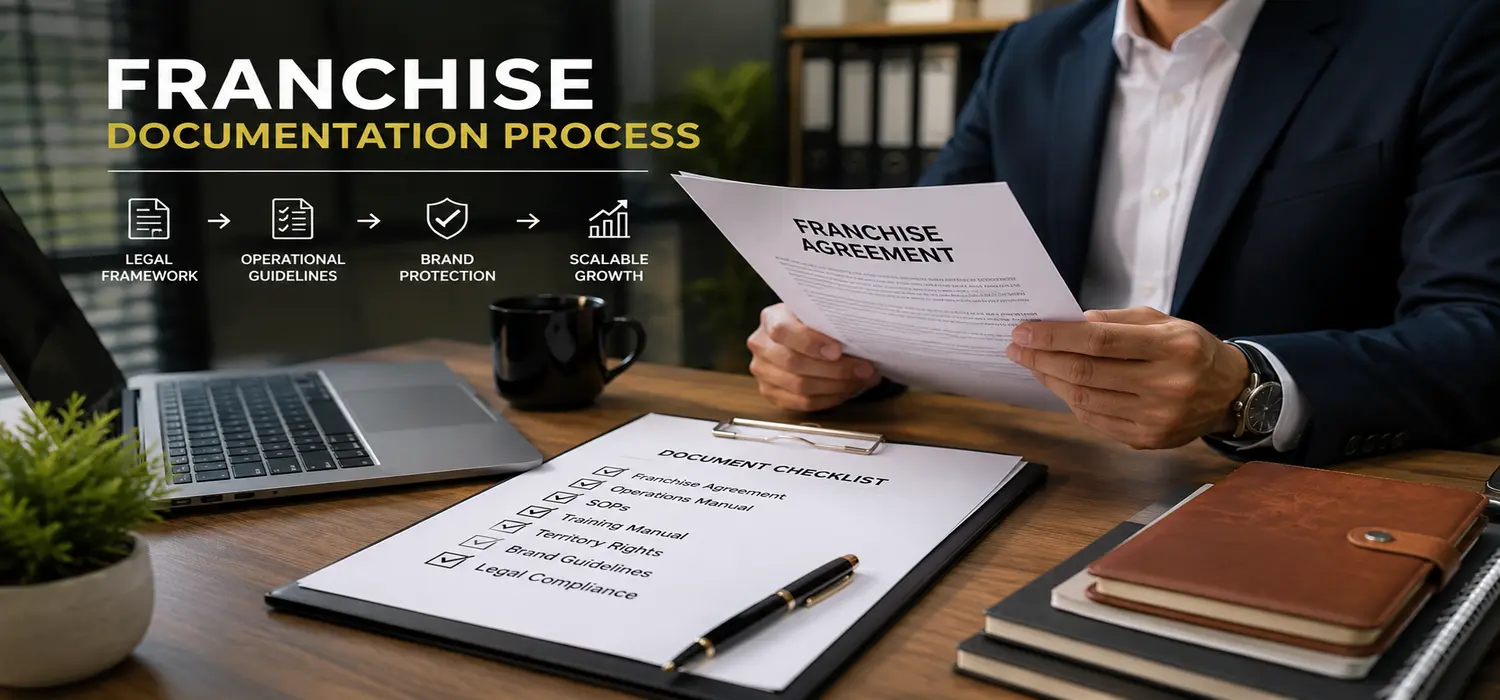
Businesses often focus heavily on branding, marketing, and franchise sales when planning expansion. Yet one of the most decisive factors behind sustainable multi-location growth is the strength of the Franchise Documentation Process.
Poor documentation creates operational confusion, franchise disputes, inconsistent customer experiences, legal exposure, and scalability limitations. Strong documentation, on the other hand, transforms a business from an owner-dependent operation into a structured expansion model capable of replicating across cities, regions, and markets.
For growing brands, the Franchise Documentation Process is not simply a legal formality. It is the operational blueprint that protects the brand, standardizes execution, and supports long-term franchise scalability.
At Strategizer, businesses across industries approach franchise expansion with a systems-first mindset. With 26+ years of combined experience, 1500+ business consultations, and 210+ brands successfully franchised, the firm has observed a clear pattern: franchise systems scale efficiently only when documentation, operations, and expansion strategy evolve together.
In Short: What Is the Franchise Documentation Process?
The Franchise Documentation Process refers to the structured creation of legal, operational, financial, and compliance documents required to franchise a business successfully. It forms one of the most important stages in the broader process of how to franchise your business successfully and build a scalable expansion model.
These documents define:
- Brand rights
- Operational standards
- Territory structures
- Revenue models
- Franchise obligations
- Training systems
- Quality controls
- Intellectual property usage
- Expansion governance
Without proper documentation, franchise expansion becomes inconsistent and difficult to control.
Why the Franchise Documentation Process Matters for Business Expansion
Many founders assume franchising is primarily about selling outlets. In reality, franchising is about replicating systems.
A business may perform exceptionally well in one location because the founder oversees operations directly. However, expansion introduces complexity:
- Different operators
- Different cities
- Different employee teams
- Varying customer behaviors
- Operational inconsistencies
- Brand dilution risks
The Franchise Documentation Process creates operational alignment across all these variables.
Global franchise industry bodies such as the International Franchise Association (IFA) also emphasize documentation standardization as a critical factor in sustainable franchise network growth.
| Business Area | Impact of Proper Documentation |
|---|---|
| Brand Consistency | Standardized customer experience |
| Legal Protection | Reduced disputes and liability risks |
| Expansion Speed | Faster onboarding of franchise units |
| Operations | Clear SOP execution across locations |
| Franchisee Management | Better accountability and governance |
| Investor Confidence | Stronger business credibility |
| Scalability | Easier regional and national expansion |
Businesses planning long-term growth should treat documentation as infrastructure rather than paperwork.
Core Documents Included in the Franchise Documentation Process
The exact documentation framework varies by industry and business model. However, most scalable franchise systems require several foundational components.
1. Franchise Disclosure and Business Information Documents
These documents explain the franchise structure, operational expectations, business model overview, and brand framework.
They typically include:
- Company background
- Brand positioning
- Business model explanation
- Revenue structure
- Franchise scope
- Support systems
- Operational obligations
This stage of the Franchise Documentation Process establishes clarity before expansion discussions begin.
2. Franchise Agreement
The franchise agreement is the central legal document governing the relationship between the franchisor and franchise partner.
Key areas covered include:
- Franchise rights
- Territory allocation
- Brand usage permissions
- Royalty structures
- Operational compliance
- Duration and renewal
- Exit conditions
- Performance expectations
Poorly drafted agreements often create operational disputes during expansion.
For brands exploring broader franchise frameworks, understanding the broader franchise development lifecycle becomes equally important alongside legal structuring.
3. Operations Manual and SOP Framework
One of the most overlooked parts of the Franchise Documentation Process is operational systemization.
An operations manual converts founder knowledge into scalable systems.
This includes:
- Daily operational workflows
- Staff management systems
- Customer service protocols
- Inventory processes
- Vendor coordination
- Quality control standards
- Reporting procedures
Businesses planning structured growth should also align documentation with a detailed SOP development strategy for franchise businesses to improve execution consistency.
4. Brand Usage and Intellectual Property Documentation
Franchise expansion increases brand exposure significantly. Without clear IP controls, businesses risk dilution and unauthorized brand usage.
Documentation should define:
- Logo usage rules
- Marketing guidelines
- Digital branding standards
- Packaging controls
- Trademark protections. -Trademark protections aligned with global intellectual property standards recommended by the World Intellectual Property Organization (WIPO)
- Advertising compliance
This becomes especially critical during regional or multi-state expansion.
5. Territory and Expansion Rights Documentation
Territory conflicts are among the most common franchise expansion challenges.
The Franchise Documentation Process should clearly define:
- Territory allocation models
- Exclusive vs non-exclusive rights
- Geographic limitations
- Expansion permissions
- Multi-unit rights
- Regional development conditions
Strategic territory planning directly impacts franchise network stability.
Common Mistakes Businesses Make During Franchise Documentation
Many growing brands approach documentation reactively instead of strategically.
Over-Reliance on Generic Templates
Template agreements copied from unrelated industries rarely reflect operational realities.
A restaurant franchise, education business, retail chain, and wellness brand require entirely different documentation logic.
Creating Legal Documents Before Operational Clarity
Legal drafting without operational systems leads to weak franchise structures.
The Franchise Documentation Process should follow operational standardization not replace it.
Ignoring Future Expansion Complexity
Documentation must support future scalability, not just current operations.
Businesses often fail to account for:
- Multi-city expansion
- Regional master franchise structures
- Digital operations
- Centralized procurement
- Multi-format outlets
- Technology integrations
Weak SOP Integration
Franchise disputes often arise because operational instructions remain verbal instead of documented.
Strong SOP integration reduces dependency on founders and improves franchise consistency.
Businesses reviewing common franchising mistakes during expansion often discover documentation gaps as a primary scaling obstacle.
The Strategic Sequence of the Franchise Documentation Process
The most effective franchise systems follow a structured development sequence rather than random document creation.
Recommended Expansion Sequence
- Business model validation
- Expansion feasibility assessment
- Franchise strategy planning
- Operational standardization
- SOP development
- Legal documentation drafting
- Compliance review
- Franchise onboarding systems
- Training documentation
- Expansion governance framework
This structured approach strengthens both operational stability and long-term scalability.
How the Franchise Documentation Process Supports Multi-Location Growth
Expansion challenges increase dramatically once businesses cross regional boundaries.
Documentation helps businesses maintain:
- Operational consistency
- Brand reputation
- Service quality
- Training alignment
- Vendor control
- Financial governance
- Customer experience standards
The Franchise Documentation Process effectively becomes the communication system between the brand headquarters and franchise network.
Businesses planning structured regional growth often integrate documentation planning with broader franchise expansion strategies for growing brands.
Franchise Documentation and Business Valuation
Strong franchise systems often achieve stronger market positioning because they demonstrate operational maturity.
Investors, lenders, and strategic partners evaluate:
- Replication capability
- Operational governance
- Risk management
- Brand consistency
- Legal protection systems
A professionally structured Franchise Documentation Process contributes to long-term enterprise value.
This is particularly important for businesses planning:
- Multi-state growth
- Institutional partnerships
- Private investment
- Strategic acquisitions
- Large franchise networks
When Should a Business Start the Franchise Documentation Process?
Businesses should ideally begin the Franchise Documentation Process before aggressive expansion starts.
Many growing Indian SMEs and emerging regional brands now explore franchising as a structured expansion strategy while scaling beyond founder-led operations.
Indicators a Brand May Be Ready
- Strong unit-level profitability
- Repeatable customer experience
- Stable operational systems
- Consistent brand demand
- Standardized workflows
- Defined management structure
- Expansion-ready leadership
Documentation should evolve alongside operational maturity.
Businesses still exploring readiness should first understand the broader process of how to scale a business through franchising before entering documentation stages prematurely.
Consultant Insight: Documentation Alone Does Not Build a Franchise System
Many businesses mistakenly believe franchise agreements alone create a franchise model.
In reality, scalable franchising requires integration across:
- Operations
- Training
- Legal systems
- Expansion strategy
- Brand governance
- Territory planning
- Financial modeling
The Franchise Documentation Process works effectively only when aligned with the overall franchise architecture.
This is why experienced franchise consulting firms focus on systems development not just paperwork.
How Strategic Franchise Consultants Improve Documentation Quality
Experienced consultants bring operational and expansion perspectives that pure legal drafting often misses.
A strategic consulting approach helps businesses:
- Structure scalable franchise models
- Align documentation with operations
- Reduce future franchise conflicts
- Improve onboarding systems
- Create scalable governance structures
- Build expansion-ready SOP ecosystems
Businesses seeking structured expansion support often work with specialized franchise consulting experts in Chennai to align documentation with long-term scaling objectives.
Final Thoughts
The Franchise Documentation Process is one of the most important foundations behind sustainable franchise expansion.
Well-structured documentation does far more than protect the business legally. It enables consistency, scalability, operational governance, and long-term brand stability.
As franchise networks grow, operational complexity increases exponentially. Businesses that document systems strategically are far more likely to scale successfully without compromising quality or brand reputation.
For growth-oriented brands, documentation should never be treated as a secondary administrative task. It is a strategic expansion asset.