
Table of Contents
ToggleFranchise Business Model for Brand Owners: A Strategic Framework for Scalable Expansion
For many growing businesses, expansion eventually reaches a critical operational question: should growth continue through company-owned outlets, or is it time to build a scalable franchise network?
The answer often depends on leadership capacity, capital efficiency, operational maturity, and long-term brand vision. A well-structured Franchise Business Model allows businesses to expand geographically without carrying the full infrastructure burden of every new location. But franchising is not simply about licensing a brand name. Businesses exploring structured expansion should first understand the broader process of how to franchise your business in Chennai before building a scalable franchise system.
For businesses evaluating structured franchise expansion frameworks, industry standards and operational best practices published by the International Franchise Association (IFA) provide useful strategic reference points.
Businesses that approach franchising strategically often create stronger multi-location ecosystems, faster market penetration, and more resilient brand structures.
Strategizer, with 26+ years of combined industry experience, 1500+ business consultations, and support provided to 210+ successfully franchised brands, has observed a common pattern across scalable companies: franchising succeeds when businesses treat it as an operational transformation not merely an expansion tactic.
What Is a Franchise Business Model?
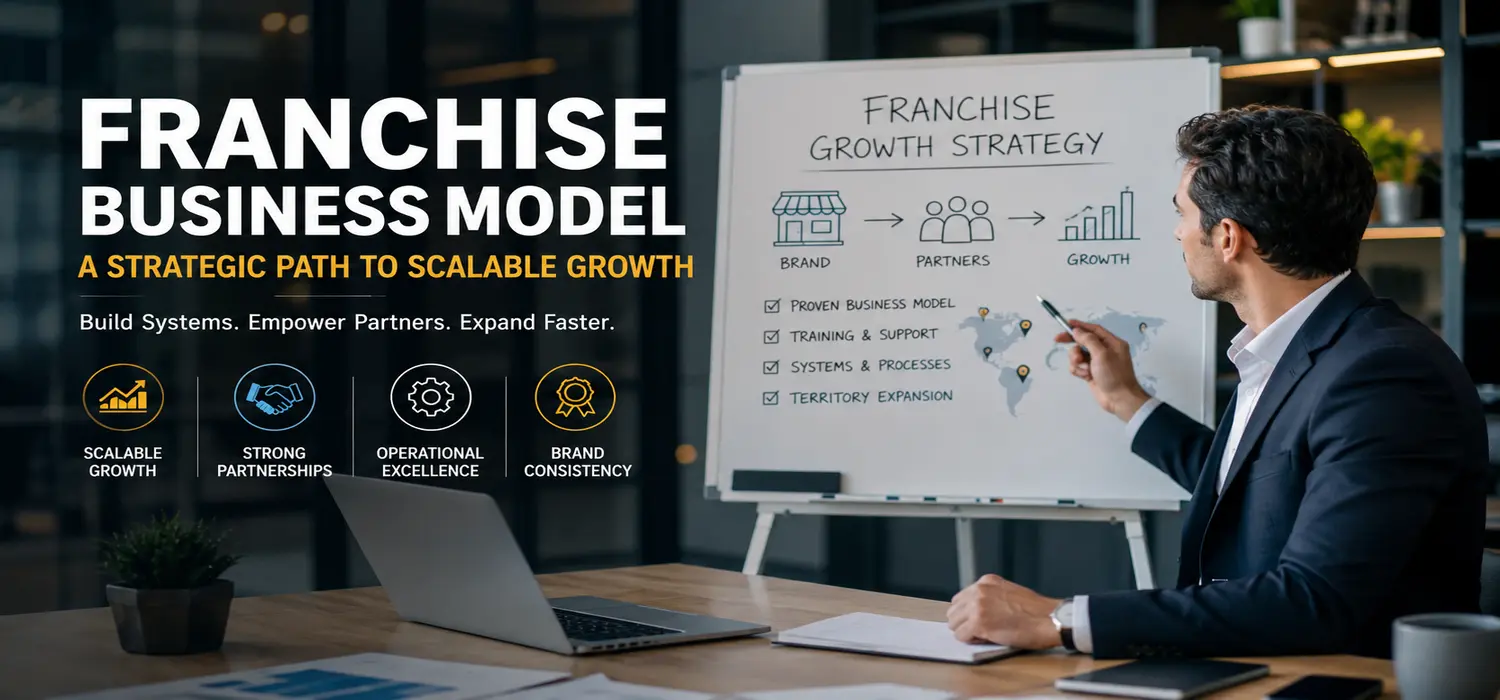
A Franchise Business Model is a structured expansion framework where a business owner (franchisor) allows independent operators to replicate its business system under defined operational, branding, and commercial standards.
In practical terms, the model enables brands to scale using:
- Standardized operating systems
- Replicable business processes
- Brand licensing structures
- Centralized operational control
- Franchise training frameworks
- Expansion-ready documentation
The objective is not just growth. The objective is controlled and repeatable growth.
In Short
A successful Franchise Business Model transforms a business from:
- Founder-dependent operations
to - System-driven scalable expansion
That distinction is what separates scalable franchise brands from businesses that struggle during multi-location growth.
Why Brand Owners Are Exploring Franchise Expansion
Modern expansion environments have changed significantly.
Businesses today face:
- Rising operational costs
- Recruitment challenges
- Geographic management complexity
- Increasing competition in regional markets
- Faster customer expectation cycles
Because of this, many founders are shifting toward franchise-led scaling models instead of relying solely on company-owned expansion.
| Expansion Factor | Company-Owned Model | Franchise Expansion Model |
|---|---|---|
| Capital Requirement | High | Lower Relative Capital Exposure |
| Operational Burden | Centralized | Shared With Franchise Operators |
| Speed of Expansion | Slower | Faster Regional Penetration |
| Market Adaptability | Moderate | Often Stronger Local Responsiveness |
| Leadership Scalability | Resource Intensive | System-Driven Scalability |
A properly structured Franchise Business Model enables businesses to scale while preserving operational consistency across locations.
Is Your Business Ready for a Franchise Business Model?
Not every business is immediately franchise-ready.
One of the biggest strategic mistakes founders make is attempting franchise expansion before operational maturity is achieved.
Key Franchise Readiness Indicators
1. Operational Consistency
If business performance depends entirely on the founder’s daily involvement, franchising becomes difficult.
Scalable franchise systems require:
- Defined workflows
- Predictable delivery systems
- Repeatable customer experiences
- Standardized quality control
This is why many brands first invest in:
- SOP development
- process documentation
- operational structuring
- staff training systems
These areas are closely connected to broader franchise system development strategies covered in guides like “How to Create a Franchise System” and “SOP Development for Franchise Businesses.”
2. Strong Unit Economics
A Franchise Business Model only works when franchise units can sustain profitability under realistic market conditions.
Businesses should evaluate:
- Average outlet profitability
- Cost-to-revenue balance
- Operational margins
- Expansion viability across locations
- Scalability of procurement and supply chains
Without strong economics, expansion only magnifies operational weaknesses.
Many growing businesses also benchmark operational scalability using small business growth frameworks and expansion resources from the U.S. Small Business Administration (SBA)
3. Brand Replicability
Certain businesses perform well in one location but fail during replication because the business relies heavily on:
- hyper-local relationships
- founder personality
- unique location advantages
- unstructured operations
Franchise-ready businesses usually demonstrate:
- repeatable customer demand
- transferable operating systems
- scalable brand positioning
- adaptable market models
Core Components of a Successful Franchise Business Model
A scalable Franchise Business Model is built on interconnected systems not isolated documentation.
Businesses often underestimate how interconnected the complete franchise development process becomes once expansion begins across multiple territories.
Operational Systems
This includes:
- SOP manuals (Detailed SOP development for franchise businesses often becomes one of the most critical foundations for maintaining consistency across expanding franchise networks.)
- workflow structures
- escalation processes
- vendor systems
- customer service standards
Operational depth becomes increasingly critical as franchise networks expand.
Franchise Documentation
Franchise expansion requires structured legal and commercial documentation such as:
Many businesses first evaluate the broader franchise documentation process to understand how legal, operational, and compliance frameworks support scalable expansion.
- franchise agreements
- disclosure frameworks
- territory structures
- licensing policies
- operational compliance systems
Brands often underestimate how important documentation is in long-term franchise stability.
Poor documentation creates:
- operational confusion
- brand inconsistency
- franchise disputes
- expansion bottlenecks
This is why many businesses explore the broader “Franchise Documentation Process” before launching aggressive expansion.
Training & Support Infrastructure
A Franchise Business Model cannot scale effectively without centralized training systems.
Strong franchise brands build:
- onboarding frameworks
- operational training modules
- location launch support
- quality audits
- performance review systems
The goal is operational replication not dependency.
Expansion Strategy Architecture
Franchise growth should never happen randomly.
A structured franchise expansion strategy for businesses helps brands prioritize territory sequencing, operational bandwidth, and sustainable market penetration.
Businesses need:
- territory planning
- market prioritization
- expansion sequencing
- operational support forecasting
- leadership bandwidth planning
This is where strategic frameworks such as “Franchise Expansion Strategy for Businesses” become highly relevant for growing brands.
Common Mistakes Businesses Make When Franchising
Many expansion failures are not caused by lack of demand. They are caused by structural weaknesses inside the business.
Many of these operational issues are explored further in discussions around common mistakes when franchising your business, especially among rapidly scaling brands.
Franchising Too Early
Businesses sometimes franchise after one successful outlet without validating operational scalability.
A scalable Franchise Business Model requires operational maturity, not just market excitement.
Weak SOP Systems
When procedures are undocumented, franchise consistency breaks down rapidly.
This affects:
- customer experience
- operational quality
- staff performance
- brand perception
Focusing Only on Sales Expansion
Some brands prioritize franchise acquisition over operational infrastructure.
Long-term franchise success depends more on:
- support systems
- operational monitoring
- scalability planning
- leadership systems
than rapid outlet growth.
Lack of Franchise Operations Governance
As networks grow, franchise operations become increasingly complex.
Businesses need:
- audit systems
- reporting structures
- franchise communication frameworks
- escalation mechanisms
- regional support planning
This operational layer becomes increasingly important in long-term franchise operations management systems where consistency and franchise support directly impact network scalability.
This operational layer is often explored in more detail within a “Franchise Operations Management Guide.”
How a Franchise Business Model Supports Multi-Location Growth
The primary strength of a Franchise Business Model is scalable geographic expansion without centralized operational overload.
Strategic Benefits for Brand Owners
Faster Regional Penetration
Franchise operators often understand local market conditions better than centralized corporate teams.
This improves:
- customer adaptation
- regional responsiveness
- market entry efficiency
Reduced Capital Burden
Expansion through franchising reduces the need for:
- large infrastructure investments
- heavy payroll scaling
- centralized operational expansion
This allows brands to allocate more focus toward:
- branding
- innovation
- systems
- franchise support
Stronger Brand Footprint
Well-managed franchise systems create:
- higher market visibility
- stronger regional presence
- wider consumer reach
- operational scalability
Over time, this creates stronger brand defensibility within competitive industries.
Industry trend analysis from Entrepreneur Franchise Resources also shows that system-driven franchise brands often achieve faster regional visibility compared to fragmented independent expansion models.
For businesses evaluating larger expansion opportunities, understanding how to scale a business through franchising helps clarify the operational and leadership shifts required during growth.
The Strategic Shift: From Business Operator to System Builder
One of the most important transitions in franchise expansion is leadership evolution.
Founders must shift from:
- running locations directly
to - building scalable systems that others can operate successfully
That mindset shift defines successful franchisors.
A mature Franchise Business Model requires leadership focus on:
- systems thinking
- process governance
- expansion planning
- operational scalability
- brand consistency
Businesses that fail to make this transition often struggle during multi-unit expansion.
How Strategic Franchise Consulting Helps Businesses Scale
Franchise development is not simply a legal process or branding exercise.
It involves:
- operational transformation
- system architecture
- expansion strategy
- documentation structuring
- process standardization
- franchise readiness evaluation
Strategizer works with businesses seeking structured expansion through scalable franchise systems, often supporting brands looking for experienced franchise consultants in Chennai for franchise readiness, operational structuring, and expansion planning. With experience across 1500+ business consultations and 210+ franchised brands, the consulting approach focuses on building operationally sustainable growth frameworks rather than short-term expansion hype.
For brands evaluating franchise-led growth, consulting support often becomes valuable during:
- franchise readiness assessment
- SOP structuring
- documentation development
- expansion planning
- operational system creation
- multi-location scalability planning
Businesses exploring structured expansion may also evaluate advisory support from experienced franchise consultants in Chennai when planning regional or national growth strategies.
Key Takeaways
A successful Franchise Business Model requires:
- Operational standardization
- Strong SOP frameworks
- Scalable training systems
- Structured documentation
- Expansion planning discipline
- Franchise governance systems
- Replicable unit economics
Most importantly:
Franchising should be approached as a long-term business systems strategy not merely a growth shortcut.
Franchise Business Model FAQs
What are the 4 types of franchise models? +
How does a franchise business model work? +
How do you create a franchise business model? +
What is a franchise model of business? +
What is an example of a franchise business model? +
Conclusion
A scalable Franchise Business Model gives businesses a structured pathway toward regional and multi-location growth. But successful franchise expansion is never built on branding alone.
It depends on:
- operational discipline
- scalable systems
- leadership maturity
- process standardization
- strategic expansion planning
For businesses serious about long-term expansion, franchising should be viewed as a business transformation framework not simply an outlet multiplication strategy.
Brands that invest early in systems, governance, and operational clarity are typically the ones that build sustainable franchise networks over time.