
Table of Contents
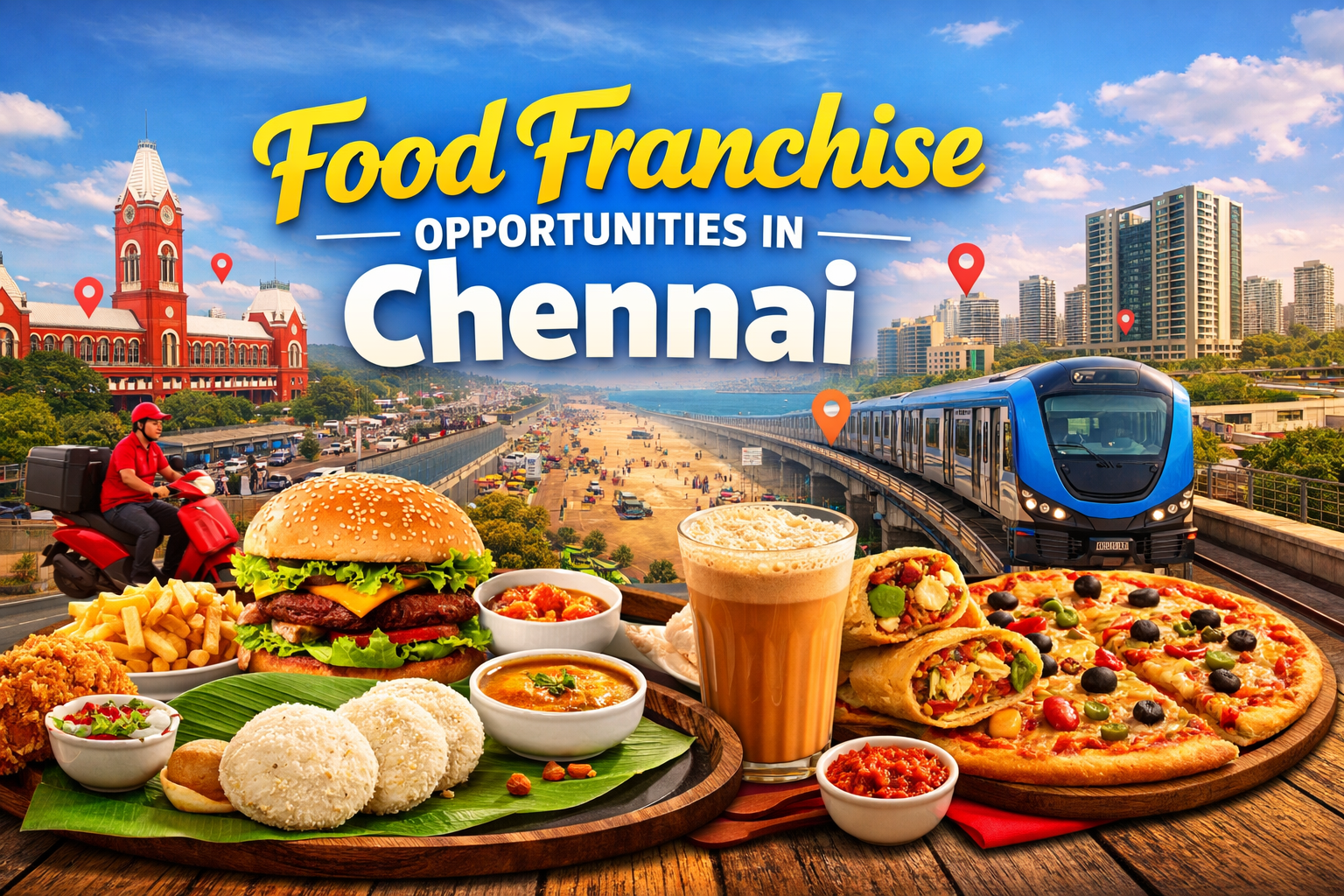
ToggleFood Franchise Opportunities in Chennai: A Complete Investment Guide for 2026
Chennai is no longer only an IT and automobile powerhouse it is quietly becoming one of India’s most dynamic food consumption markets. Rising disposable incomes, expanding residential corridors, new metro lines, and evolving dining habits are creating sustained demand for organized food brands across both full-service and delivery-first formats. For entrepreneurs and investors, that demand translates into measurable franchise opportunities from micro cloud kitchens that start under ₹1 lakh to full QSR outlets that can scale across Tamil Nadu.
This guide gives you a practical, numbers-first blueprint for evaluating, selecting, and launching food franchise opportunities in Chennai in 2026 including investment brackets, unit-economics, legal and operational traps, location frameworks, aggregator risks, and conversion-ready recommendations for scaling. Read it end-to-end if you’re serious about building a predictable, profitable outlet.
| Factor | Practical Insight |
|---|---|
| Average Investment (Typical Range) | ₹1 Lakh → ₹25+ Lakhs Depending on Format |
| Typical Break-even Timeline | 6 → 24 Months (Format Dependent) |
| Typical Gross Margin (QSR / Snacks) | 50% → 70% |
| Typical Net Margin (Well-Run Outlet) | 12% → 25% |
| Risk Level | Moderate — Highly Location Sensitive |
| Ideal For | First-Time Entrepreneurs, Family-Run Businesses, Working Professionals Seeking Side Income |
Market Snapshot: Why Chennai Matters (Numbers & Trends)
India’s foodservice market has been expanding rapidly, driven by urbanisation, higher disposable incomes, and a shift toward branded, convenience-led formats. Recent market estimates place the India foodservice market in the tens of billions of dollars and projecting double-digit growth over the next decade. India food service market growth report
At the city level, the Chennai Metropolitan Region has been growing strongly population projections for 2026 put the metro region above 13 million residents, increasing both density and addressable delivery demand across suburbs. Higher urban density plus concentrated IT corridors (OMR, Sholinganallur, and Velachery) create daily demand pockets for breakfast, lunch and evening deliveries.
The Quick Service Restaurant (QSR) segment the backbone of scalable food franchising is also expanding at high single-digit to low-double-digit CAGR in India, making proven QSR formats highly attractive for franchise expansion. (Detailed market insights on QSR expansion trends are available in recent industry research) India QSR market analysis
Finally, the cloud-kitchen segment continues to outpace many traditional formats with a faster CAGR and a delivery-first footprint that fits high-density Chennai suburbs; analysts estimate strong multi-year growth for cloud kitchens in India.
Which Food Franchise Formats Work Best in Chennai (and Why)
Chennai’s geography, culture and commuter patterns favor some formats over others. Below are the formats that show repeatable unit economics in 2026.
1. Quick Service Restaurants (QSR)
Best for high-footfall streets, commercial hubs, and near colleges.
Pros: predictable ticket size, brand recall, easier SOPs.
Cons: higher rent, capex and staffing needs.
2. Compact Takeaway / Kiosk Models
200–400 sq.ft takeaway counters in malls or inside large housing complexes.
Pros: lower capex, faster break-even.
Cons: limited seating, peak-hour dependence.
3. Cloud Kitchens / Delivery-first Kitchens
Delivery-only kitchens optimized for aggregator orders and own-app pickups.
Pros: low rental, multi-brand hosting, rapid menu iteration.
Cons: heavy aggregator commissions and discovery dependency.
Recent market studies show sustained growth momentum for delivery-first kitchen models across urban India. India cloud kitchen market report
4. Beverage & Tea Chains
High margin per SKU, relatively lower complexity.
Pros: low capex, easier staffing.
Cons: saturated pockets in certain micro-markets.
5. Traditional South Indian Full-day Outlets
Cultural fit for Chennai repeat breakfast, lunch and dinner customers.
Pros: high repeat-frequency, local demand.
Cons: operations require strong execution and supply chain for fresh staples.
Investment Brackets: What to Expect (Realistic Ranges)
When evaluating food franchise opportunities in Chennai, the most important starting point is investment clarity. Not all food franchise businesses in Chennai require ₹20+ lakhs. In fact, the Chennai market supports multiple entry brackets from micro cloud kitchens to full-scale dine-in QSR formats.
Understanding what each investment level truly includes will help you choose the right food franchise in Chennai based on capital strength, risk appetite, and involvement level.
Micro / Home Cloud Kitchen Below ₹1 Lakh
This is the lowest entry point into the food franchise business in Chennai. While traditional franchise brands rarely operate at this level, some emerging cloud kitchen models and subscription-based food concepts allow entry under ₹1 lakh.
Typical Setup
Home-based or shared kitchen model
Limited menu (4–10 SKUs)
Swiggy / Zomato onboarding
Basic branding and packaging
Small-scale digital marketing
What the Investment Covers
Basic kitchen equipment (induction stove, refrigerator, utensils)
Packaging material
Raw material for first 2–4 weeks
Food license registration
Delivery aggregator onboarding fees
Scalability
Scalability is limited unless you formalize operations into a commercial kitchen space. Most micro food franchise in Chennai below 1 lakh operate as test models before scaling.
Best For
First-time entrepreneurs
Housewives starting tiffin services
Side-income seekers
Low-risk experimentation
This model works best in dense residential pockets like Medavakkam, Tambaram, and Velachery, where delivery demand is consistent.
Small Format Kiosk ₹1 Lakh to ₹3 Lakhs
This is one of the most searched brackets for food franchise opportunities in Chennai with low investment.
Small beverage chains, tea franchises, juice outlets, and dessert kiosks fall into this range.
Typical Setup
80–150 sq.ft kiosk
Mall corridor / roadside counter
1–2 staff members
Limited preparation complexity
What the Investment Covers
Basic kiosk fabrication
Small commercial equipment
Franchise fee (if applicable)
Initial marketing material
Raw materials and staff uniforms
Break-even Expectation
With correct location strategy in Chennai, break-even can happen within 8–14 months.
However, this segment is highly location sensitive. Rental cost must not exceed 10–12% of projected revenue. Many small food franchise in Chennai below 3 lakhs fail because rent is miscalculated.
Small Branded Outlet ₹3 Lakhs to ₹7–10 Lakhs
This bracket offers one of the best balances between investment and scalability in the Chennai food franchise market.
If someone searches food franchise in Chennai below 5 lakhs, this is the serious opportunity range.
Typical Setup
200–350 sq.ft takeaway QSR
Branded interiors
Limited seating or standing model
Structured menu and SOP
What the Investment Covers
Franchise fee
Basic interior setup
Commercial kitchen equipment
Initial inventory
Staff recruitment and training
Branding and launch promotion
Revenue Potential
Monthly revenue in Chennai suburbs can range between ₹3 lakhs to ₹6 lakhs depending on footfall and aggregator performance.
Break-even Timeline
Typically 10–16 months in strong micro-markets such as:
Anna Nagar
Velachery
Porur
Tambaram
OMR stretch
This is often the sweet spot for investors looking for profitable food franchise opportunities in Chennai.
Full QSR / Dine-in Outlet ₹10 Lakhs to ₹25+ Lakhs
This is the structured, scalable franchise model.
Well-known QSR brands and established regional chains operate in this bracket.
Typical Setup
400–1200 sq.ft outlet
Full kitchen + dine-in seating
5–12 staff members
POS + billing systems
Brand-standard interior layout
What the Investment Covers
Higher franchise fee
Premium interiors
Commercial kitchen equipment
Initial marketing launch campaign
Working capital buffer
Break-even Timeline
18–36 months depending on:
Brand pull
Location strength
Rental negotiation
Operational discipline
In high-demand areas like OMR or Anna Nagar, strong brands can scale faster due to built-in brand recall.
Unit Economics: Practical Worked Example (Numbers You Can Use)
Understanding unit economics is what separates emotional investors from strategic investors.
Before investing in any food franchise in Chennai, build a 3-month P&L projection and a 12-month revenue model.
Let’s take a realistic example of a 300 sq.ft QSR in a Chennai suburb.
Revenue Assumptions
Average daily orders: 120
Average order value (AOV): ₹150
Monthly revenue:
120 × 30 × ₹150 = ₹5,40,000
This is achievable in medium-density areas near residential + IT corridors.
Typical Monthly Cost Structure
| Expense Category | Estimated Amount |
|---|---|
| Food Cost (30–40%) | ₹1,62,000 |
| Staff Salaries | ₹80,000 |
| Rent | ₹60,000 |
| Utilities & Packaging | ₹30,000 |
| Royalty + Marketing (6%) | ₹32,400 |
| Miscellaneous | ₹15,000 |
Monthly Profit Calculation
Gross Margin After Food Cost:
₹5,40,000 – ₹1,62,000 = ₹3,78,000
Operating Expenses Total:
₹2,77,400
Estimated Net Profit:
₹1,00,600
Net Margin ≈ 18–20%
This is considered healthy for a well-managed food franchise business in Chennai.
Important Benchmarks:
Rent should not exceed 12% of projected revenue
Food cost should remain within 30–40%
Royalty ideally under 8%
Even small variations in these numbers significantly impact break-even.
Franchise Agreement: Key Clauses to Negotiate
Before investing in food franchise opportunities in Chennai, carefully review the franchise agreement. Many first-time franchisees overlook contract details and later face operational restrictions.
Critical Clauses to Evaluate
Franchise fee vs refundable deposit clarify refund conditions
Royalty structure fixed % or slab-based?
Marketing contribution included in royalty or separate?
Territory exclusivity is your area protected?
Minimum sales obligations
Mandatory vendor sourcing
Exit clause and lock-in period
Transfer fee if you sell the outlet
A clear franchise agreement directly impacts your long-term profitability and operational flexibility.
Working Capital & Early-Stage Cash Planning
Capex alone is not enough. Working capital determines survival.
Keep at least 3–6 months of buffer funds.
Working Capital Includes:
Salaries and statutory compliance
Raw material buffer
Aggregator payout delays
Emergency equipment repair
Marketing campaigns during slow months
Seasonal dips (especially post-festival or exam season in Chennai) can reduce footfall temporarily. Without adequate working capital, many food franchise outlets struggle in the first year.
Location Framework: Micro-Site Selection Rules
Location is the single biggest success factor in food franchise business in Chennai.
Use this structured approach instead of intuition.
1. Demand Density
Check:
Residential apartments within 500 meters
Nearby IT offices
College campuses
Retail clusters
2. Visibility & Access
Road-facing preferred
Parking availability
Delivery rider convenience
3. Rental Cap
Rent should ideally remain below 12% of projected monthly revenue.
4. Competition Mapping
Study 500-meter radius:
Direct competitors
Same cuisine outlets
Pricing positioning
5. Multi-Daypart Potential
Can the outlet earn during:
Breakfast
Lunch
Evening snacks
Late night
Suburbs like Anna Nagar, Velachery, Tambaram, Porur, Medavakkam, and OMR continue to show strong demand for organized food franchise models.
Aggregator Dependency: Real Risk, Practical Mitigation
Delivery platforms are growth accelerators but margin reducers.
Typical aggregator commission in Chennai ranges between 15% to 35% depending on promotional placement.
High dependency can reduce profitability.
Risk Factors
Commission escalation
Discount wars
Ranking algorithm changes
Payment cycle delays
Practical Mitigation
Build WhatsApp ordering system
Encourage repeat customers through loyalty offers
Offer small discount for direct pickup
Optimize packaging to reduce refund claims
A balanced mix of aggregator + direct orders improves long-term sustainability of food franchise operations.
Supply Chain, Procurement & Inventory Controls
Operational stability defines profitability.
Best Practices
Partner with suppliers who maintain cold chain
Negotiate bulk pricing for high-volume SKUs
Maintain backup vendor for critical items
Implement FIFO system
Weekly stock audit
Reducing wastage by even 3–4% can significantly increase net margins.
Real-World Case Study: Velachery (Mid-Investment Win)
Scenario
An IT professional invested ₹4.5 lakhs into a South Indian QSR format in Velachery.
Execution Strategy
300 sq.ft takeaway model
Focused menu (idli, dosa combos, snacks)
Delivery aggregator onboarding
Local WhatsApp marketing
Weekend mall sampling
Results (After 13 Months)
Monthly gross revenue: ₹4.2 lakhs
Net margin: 21%
Break-even: 13 months
Why It Worked
Precise micro-location selection
Strong breakfast + evening sales cycle
Controlled rent
Efficient operations
This example shows that food franchise opportunities in Chennai can deliver consistent returns when unit economics and location strategy align.
Common Mistakes New Franchisees Make
Choosing brand without studying Chennai demand pattern
Underestimating working capital
Ignoring rental negotiation
Overspending on interiors
Poor staff management
Not tracking daily cost percentage
Avoiding these mistakes improves survival probability significantly.
Menu Engineering & Pricing Strategy
Menu engineering drives profitability.
Smart Tactics
Focus on top 20% high-margin SKUs
Bundle products during slow hours
Introduce add-ons for higher AOV
Control portion size strictly
Remove low-selling items quickly
Small improvements in average order value increase annual revenue dramatically.
Technology Stack: Minimal but Powerful
Technology increases operational clarity.
Essential tools:
POS with inventory tracking
Kitchen Display System (KDS)
Aggregator analytics dashboard
WhatsApp Business ordering
Payroll tracking system
Avoid unnecessary software expenses during early stages.
Regulatory Checklist (India & Chennai-Specific)
Every food franchise in Chennai must comply with:
FSSAI registration (Basic/State/Central based on turnover)
GST registration (if applicable)
Local municipal trade license
Fire safety norms (for dine-in)
Labor compliance (PF/ESI if required)
Ignoring compliance can lead to penalties and temporary closure.
How to Choose the Right Food Franchise for You
Before investing in food franchise opportunities in Chennai, ask yourself:
What is my total budget including working capital?
Do I want daily operational involvement?
Does the brand provide marketing support?
Is territory exclusive?
Are unit economics proven in Chennai?
Have I visited existing franchisees?
Choosing the right model matters more than choosing the most popular brand.
Conclusion: Building a Profitable Food Franchise in Chennai Requires Strategy, Not Luck
Chennai’s food ecosystem is expanding in a structured, data-driven manner. Rising urban density, IT corridor expansion, increasing delivery adoption, and a clear shift toward organized brands are reshaping how consumers spend on food.
However, opportunity alone does not guarantee success.
The profitability of food franchise opportunities in Chennai ultimately depends on five controllable factors:
Location precision
Rent-to-revenue discipline
Working capital planning
Menu engineering and cost control
Operational consistency
Entrepreneurs who treat franchising as a financial model not an emotional decision are the ones who achieve sustainable returns.
Low-investment formats below ₹3 lakhs can generate strong cash flow when run efficiently. Mid-investment kiosks below ₹5 lakhs can scale steadily with disciplined execution. Larger QSR investments above ₹10 lakhs can produce long-term brand equity and multi-unit expansion opportunities.
The key is alignment between:
Capital strength
Risk appetite
Operational involvement
Local demand
Chennai offers the demand.
The franchise brand offers the system.
Execution determines the result.
For serious investors, 2026 is not just another year it is a strategic window where structured food businesses are outperforming unorganized competitors across Tamil Nadu.
Approach it with analysis.
Validate your numbers.
Protect your margins.
Scale with discipline.
That is how a food franchise in Chennai becomes a long-term asset rather than a short-term experiment.